Pe Direito (Off on the right foot)
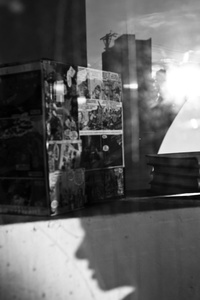
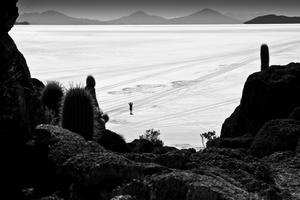
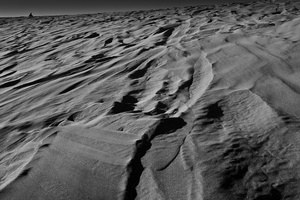
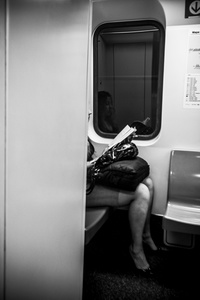
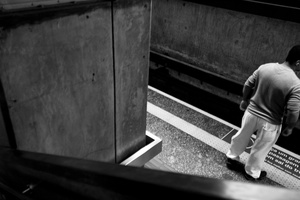
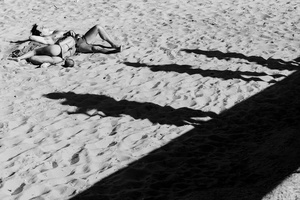
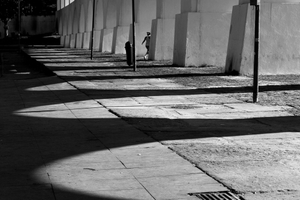
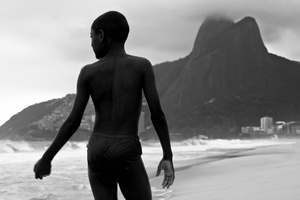
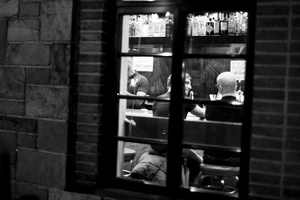
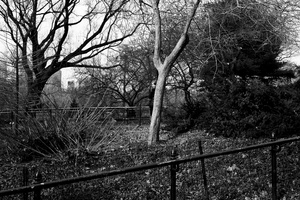
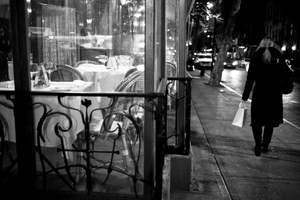
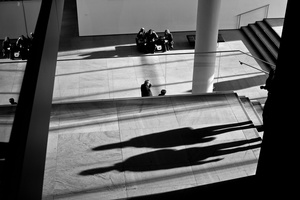
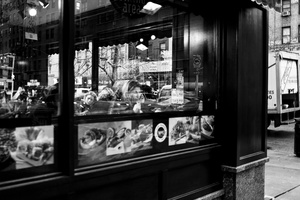
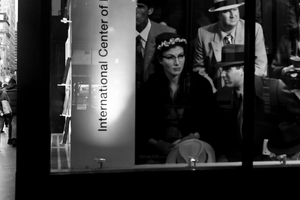
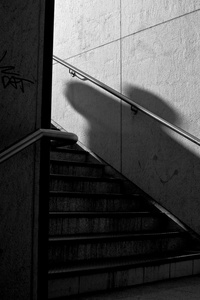
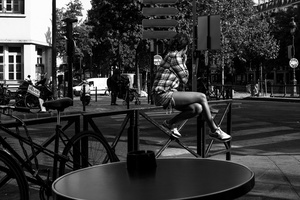
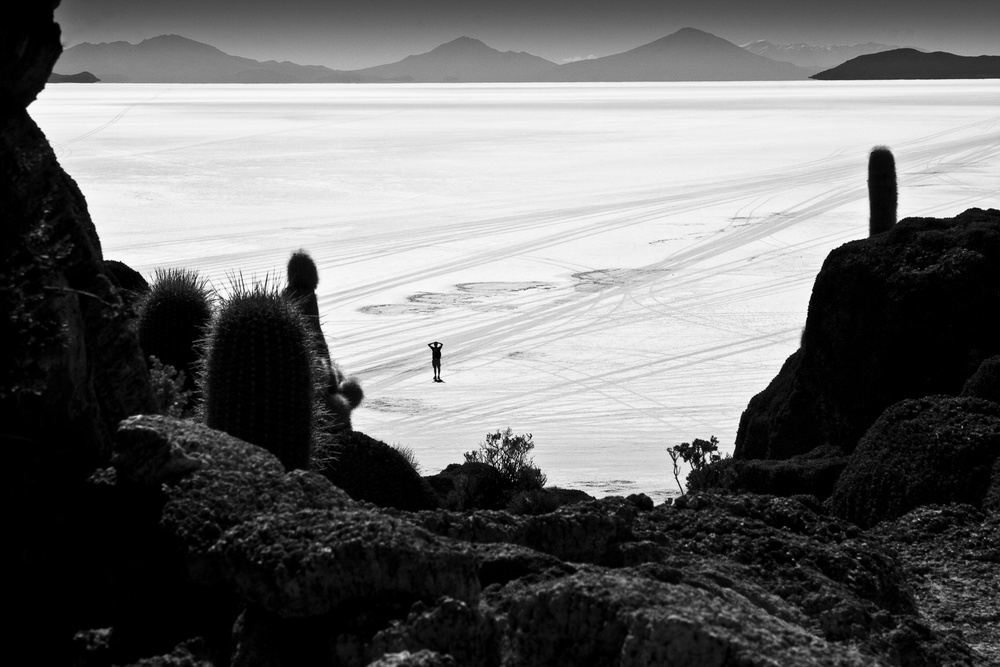
Essay by Luis Cancel - Curator Pé Direito, a popular Portuguese colloquialism that means “off on the right foot,” is a very appropriate title for Paulo Fabre’s first one-person exhibition in New York City. The phrase is often used by Brazilians to denote a good beginning and the interactions I have shared with this maturing photographer have convinced me that his depth of talent and commitment to the art form will have long-term impact. There is something at the core of artists that compels them to seek a creative outlet, even when the individuals don’t initially think of themselves as artists. The history of art and photography provides us with numerous examples of artists who abandoned successful professional careers in order to give voice to their creativity: a stock broker (Paul Gauguin), an engineer (Alexander Calder) or a stock exchange clerk (André Kertész) to name just a few. For Paulo Fabre, a young marketing executive in an São Paulo corporation, Kertész seemed like the North Star, providing both inspiration and a direction. A native of Santa Catarina, Brazil, Fabre began his journey, much like Kertész did, as a self-taught photographer. He picked up a vintage Nikon FM film camera at the age of 29 – the camera was as old as he was – and he initially read self-help technical books on film processing and darkroom technics. Eventually, Fabre’s passion for this medium would compel him to leave his native city and take classes with the Master photographer Carlos Moreira in São Paulo. Moreira introduced Fabre to the history of photography and highlighted pioneering photographers, like André Kertész, the Hungarian-born photographer who excelled at the use of the small hand-held 35mm camera to capture spontaneous and fleeting moments. Moreira also introduced Fabre to famous painters, providing the aesthetic foundation for Fabre’s overall artistic vision. “Painting is very important to me and I view them more often than I do the work of other photographers.” Fabre said in an interview with me. In 2009 the inner creative tsunami building up within Fabre broke through to the surface when he began using his weekends searching for images by exploring on foot his adoptive city of São Paulo. “I wanted to capture something different, I was seeking to establish a personal style. I wanted to make a statement. The photos were taken very quickly, like a shark attack. When I’m doing my street photography I need the quick movements of the shark.” This lightning fast capture of a fleeting moment is epitomized in the earliest photo in the exhibition, Super Mind (2009) taken in front of an São Paulo storefront. During this period, Fabre was exploring the effects of reflection and the interplay of light and shadow in the composition of a photograph. He had paused to cross the street when he noticed a pedestrian approaching the storefront that was behind him – he waited for the person’s shadow to reach the right spot and quickly lifted his camera and took the shot, being mindful to keep the person’s body outside of the picture frame. The resulting image, filled with indirect references to a human presence: the reflection of a high-rise apartment building across the street; the table laminated with comic-book illustrations; the shadow of a face, all come together in the image but seem to raise more questions than answers. The subversion and undermining of the impartial, objective lens, and its ability to coldly capture what’s in front of it, seems to delight Fabre. The exploration of ambiguity guided my selection of Fabre’s work, finding affinity with Kertész’ philosophy, according to John Szarkowski, “Kertész had never been much interested in deliberate, analytical description; since he had begun photographing in 1912 he had sought the revolution of the elliptical view, the unexpected detail, the ephemeral moment – not the epic but the lyric truth.” The images I selected for Fabre’s exhibition have an affinity with Kertész’ view of photography and mostly hew to a few specific principles: • Capturing ephemeral moments – blink and the events have passed • The furtive observer – moments of everyday life captured at a distance • Fundamentalist photography – a purist black and white photographic style with clear compositional geometry. Many of the selected images in Pé Direito contain one or more of these qualities. Ephemeral Moments The physics of photography, designed to fix a moment out of the endless stream of time and life, teases us to examine a fleeting moment at our leisure. The camera’s ability to fractionally divide a second, 1/125th of a second, 1/250th of a second, and so on, has allowed humankind to discover truths about nature not visible to the naked eye – think back to the debate surrounding whether a horse’s hooves all ever left the ground – a debate put to rest by the methodical photography of Muybridge in 1878. But you don’t need the mechanical speed of a shutter to savor the fixing of life’s passing moments. The juxtaposition of different time scales in Fabre’s Leblon (2011) gives the image a richness that delights the senses: the geological time scale of the mountain, Morro Dois Irmãos in the background, the playful youth representing the human time scale and the ever pounding surf on the beaches of Leblon, the result of gravitational forces acting within the cosmic scale. Rich and poor alike share these beaches and all of those elements were combined by Fabre’s quick hand and camera. “It was a cloudy day. I lived at that time in Ipanema and I would take advantage to walk along the beach. Cariocas don’t like cloudy days and for the most part the beach was deserted. As I walked I noticed 3-4 children playing in the surf. I let them get comfortable with my presence and I began to remember how I would play in my youth, as I photographed them.” But there are other images in the exhibition that combine an ephemeral moment with a life altering decision: Bolivian Salt Desert and Valle de la Muerte (both 2010) are such examples. In March of that year the tension between his professional career and his love of photography reached a crisis point as he undertook his first photographic foreign excursion to Bolivia and Chile. “I went alone, with my camera and a backpack and it was clear to me that the trip was an inner voyage as well. I flew to Bolivia and then took a train and a bus to reach a small city called Uyuni, where I joined a jeep convoy that crosses the dry lakebed that constitutes the Salar de Uyuni or salt flats. The convoy stopped at this outcrop of hills that once were islands and I went off on my own, leaving the other tourists behind, to climb the island. From this higher vantage point, I could see patterns in the desert and I took the photo, which represents for me, the precise moment when I decided to follow a different path in my life.” The second image, dominated by the sand dunes of the Chilean Atacama Desert that represents the endpoint of his voyage, epitomizes the frail existence of humankind in the face of an inhospitable environment. You have to strain your eyes to notice the lone, solitary figure sitting on the crest of the dune, deep in contemplation. Fabre confessed that his emotional turmoil at this point in his life made him puke, a physical act that coincided with his inner decision to eject his professional life and seek the path of the artist. Within five months of this trip, Fabre would turn his back on São Paulo and venture into a new phase in Rio de Janeiro. The Furtive Observer In August of 2010, Fabre uprooted himself and moved to “cidade maravilhosa” (the marvelous city, Rio de Janeiro’s nickname). He was committed to photography but came to that city more out of a love connection than an artistic mission. Fabre’s idealized version of Rio soon gave way to reality – the relationship ended within a few months, the burning sun and heat made his photo excursions painful during the day and dangerous at night. He was left with a brief band of time before the twilight in which to find and capture images that would not replicate the million tourist snapshots taken everyday. Praia Vermelha (2010), taken two months after his arrival and shortly after his breakup, uses strong diagonal elements to point at the young couple basking in the late afternoon sun. The elongated diagonal shadows connected to a strong dark base jut out menacingly at the unsuspecting couple, like spears or darts aimed at their exposed flesh. It is the emergence of a visual vocabulary that will use architecture and pronounced shadows to give a sense of foreboding. After leaving Rio at the end of 2011, one of the first images that Fabre took in New York City, where he came to immerse himself for three months of culture and photography, was Central Park (2012). It is an image with a monochromatic tonality, a grey winter scene filled with the branches and filigree of bushes that nearly obscures a lone figure in the center of the image – a young woman behind a tree totally lost in her inner world. This achingly silent picture seems to evoke great solitude, even in the middle of the bustling city that surrounds the park. To compound the sense of isolation the woman is standing in a fenced-off patch of greenery not meant for park visitors. Fabre has stolen a moment of deep, somber contemplation and frozen it in time… the young woman will be eternally in solitude. Other examples of the hidden/voyeur observer’s perspective include: Upper East Side, Mid-Town, Young Bardot, (all 2012), and West Village where Fabre almost assumes the role of a stalker or paparazzi spying on the friendly conversation of two men at a bar. We don’t know the nature of the relationship between the two subjects, are they strangers, are they friends, are they lovers? It is the type of noir photography that we have come to associate in popular culture with private detectives and blackmail schemes. The hidden/voyeur observer emerged early in Fabre’s work with a series he shot during the 2010 World Cup finals. The Brazilian passion for soccer is almost without parallel – the country literally comes to a standstill during any of its matches – the roads are devoid of traffic and the streets are empty. With the Brazilian loss in its quarterfinal match against the Netherlands on July 2nd Fabre felt free to roam São Paulo during the remaining games and explore the uncommon stillness in the mega city. Two photos in the exhibition, Waiting and Untitled were taken in the São Paulo metro during those periods of surreal calm in the usually bustling city. Fundamentalist Photography In New York, Fabre’s commitment to photography was total. He was taking classes at the world-renowned International Center of Photography (ICP); he spent part of every day visiting museums and immersing himself in their collections; and he was taking photographs, lots of photographs. MoMA (2012), one of the early photos during that three-month period, illustrates the core aesthetic principles Fabre was internalizing: the strong architectural geometry is disrupted by shadows involving both people and other structural elements. It is a composition animated by diagonals crisscrossing each other and dominated by deep dark and bright grey areas. Sixth Avenue (2012) is another example of how Fabre was ‘painting’ with light and dark. The recognizable elements in the picture are minimal – a handrail and the elongated shadow of a man that is descending from somewhere above – they are the only clues that we are looking at a photograph of a stairwell. Fabre took Kertész’ “elliptical view” to heart, using only the core elements of photography, light and shadow, black and white, he managed to subvert the camera’s lens by not revealing all there was to see. Forcing the viewer to fill in blanks, leaving visual clues but no obvious conclusion. These are photos that the mind must process; they don’t reveal their content automatically. Fabre’s photographs of this period have a strong ‘Fundamentalist’ view of photography, like a born-again believer in the craft: “One of my biggest interests was to photograph the light that I saw, it was the most beautiful. I was fascinated with the light of the late afternoon and how that light affected objects or anything that it touched. I started to look at buildings, structures and people or anything that was touched by that golden light with great interest. This often was my most productive period of the day.” One of the photographers leaving an imprint on Fabre during this NY period is the street photographer and photojournalist Weegee (Arthur Fellig), known for his stark black and white work, whose oeuvre he got to view in the ICP exhibition Murder Is My Business. Although Weegee would earn his livelihood by shooting crime scenes, arriving sometimes before the police did, it is his non-crime photography that left an impression on Fabre – the spontaneity of many of those images, the use of black and white photography and his ability to capture the gritty reality of NYC nightlife, as well as the photographer’s humble nature, all struck a chord within Fabre and his image ICP (2012) is his homage to the King of noir photography, whose photo can be seen in the vitrine. Pé Direito is in fact a very good beginning and an introduction to the work of Paulo Fabre. Having shed his professional, corporate skin, the emergence of the artist/photographer is well underway. In his own words, “I recently saw a documentary on Nina Simone and they asked her ‘What does it mean to you to be free?’ and she replied, ‘To be free is to live without fear.’”
No categories selected
Photos (22)