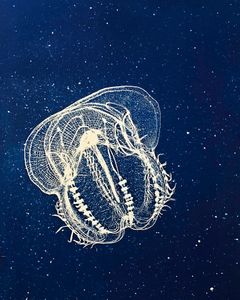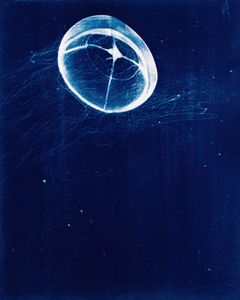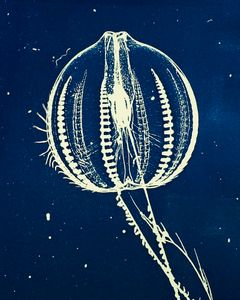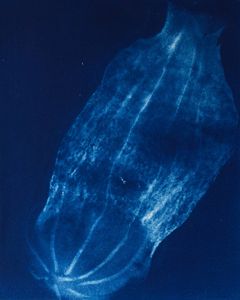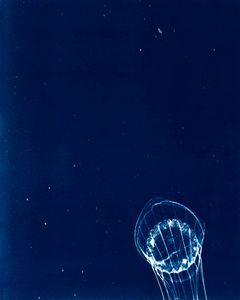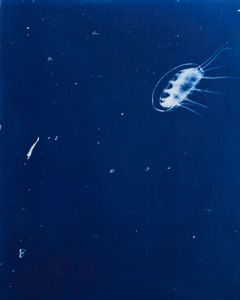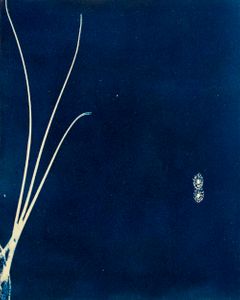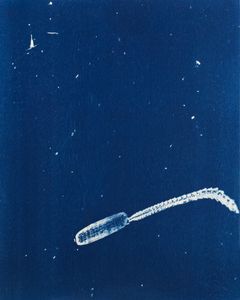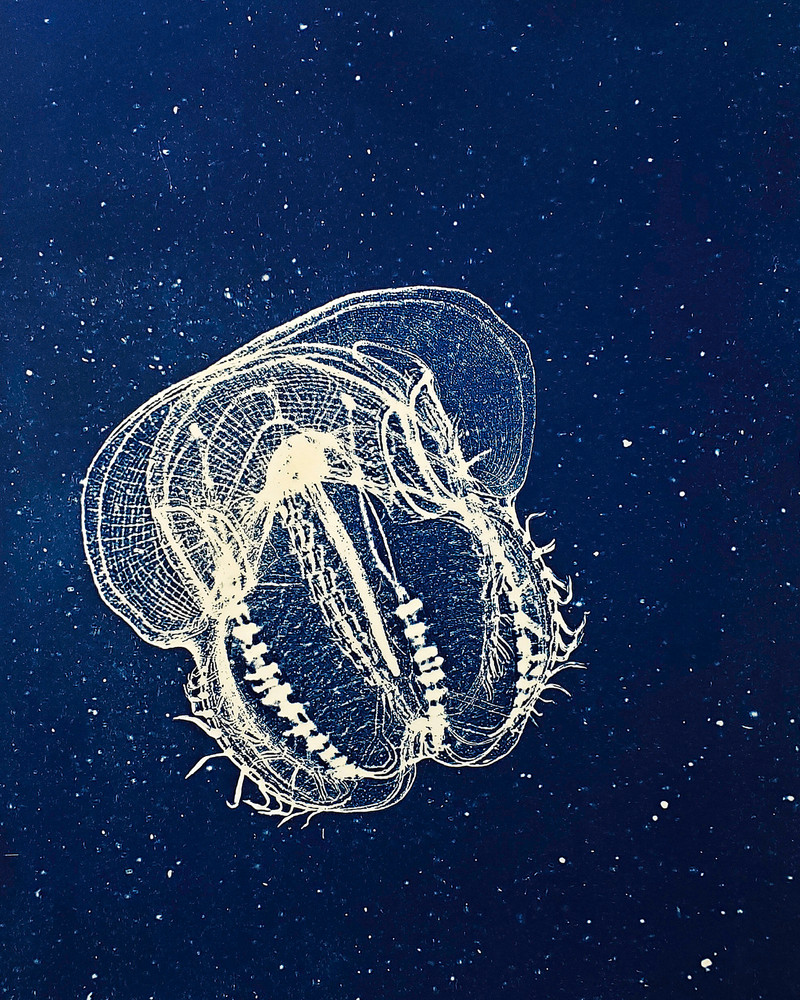

Photographs of Pacific Plankton, Cyanotype Impressions
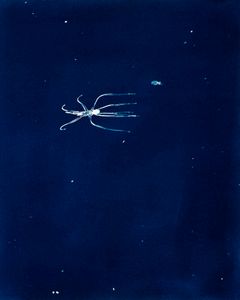
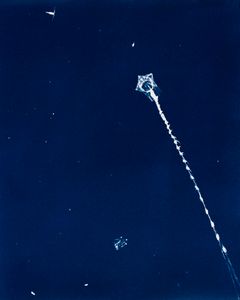
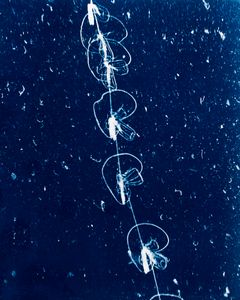
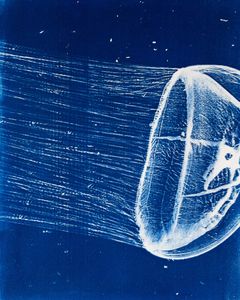
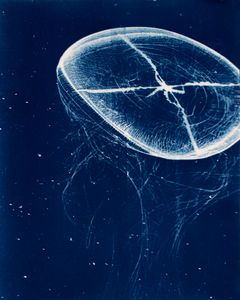
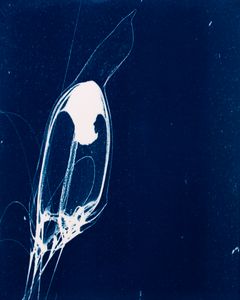
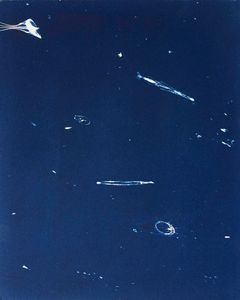
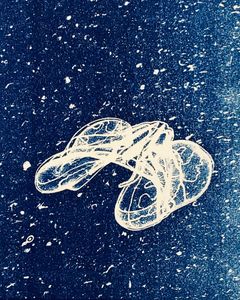
Portraits of Pacific Plankton: Cyanotype Impressions grew out of a desire to speak to one of the burning issues of our lives, climate change, and to reflect on both the ways our society has changed and how it has remained the same through the advances of technology that have led us to the present. In 2019, as the artist in residence on a science research vessel off the Pacific coast I worked with several teams of scientists studying the effects of climate change on the zooplankton food-web. On the boat, we used a specialized underwater imaging system which captures the shadow of anything that crosses in its light at a rate of 90 frames a second. The scientists are using the images to build an AI system for species identification and to quantify the number of plankton in the water at the same place every year over time. Unlike many other creatures, the population of plankton is exploding as oceans warm. As the plankton biomass increases the water becomes increasingly corrosive, killing other sea life, which is also exacerbated by overfishing, and the once closed system of the ocean now releases carbon into the air adding to global warming. The plankton are innocent culprits in causing climate change, their numbers outline the ocean health. Most of the Pacific Plankton images were collected by chance using these underwater cameras. Consequently, the viewer sees the jellyfish, seaworms and other creatures floating in their habitat, sometimes partially blurred, or moving out of the frame. Others have been brought up out of the water and we see them through the lens of a microscope. The images collected here are a few of the results of this collaboration and form the beginnings of a trans-temporal and transcontinental dialog that will create a new book, Portraits of Pacific Plankton: Cyanotype Impressions. My project has a distinct historical component. To weave the history of science and photography into the complexity of climate change we start in 1843, four years after the invention of photography. This is when the woman credited with being the first woman photographer published the first book produced photographically. The book was titled, Photographs of British Algae; Cyanotype Impressions, and the photographer was Anna Atkins. Ironically, she was not given credit until recently, a reflection of the change in attitude towards the accomplishments of women in our cultural view. In order to address both my concern for climate change and the prominence of women in that struggle, my work honors Anna Atkins’ achievement. My plankton photographs use the same format (8”x 10”), the same printing technique (cyanotype on watercolor paper), and like her work, mine is a compendium of various species presented in folio editions. These similarities are combined with the great advances in technology that have been made since her time; digital capture, underwater photography, and photo-microscopy, to create images that meld time and space. When Anna Atkins was making her cyanotypes, the role of the zooplankton food-web was fairly unimaginable as was the climate change that is visible through changes in that food-web. This project, thus, not only reawakens the excitement of the age of discovery but speaks to the current fragility of our planet.
No categories selected
Photos (16)