
What Love Has to Do With It
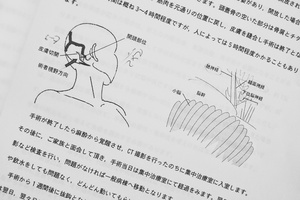
So it starts out with a twitch, a little twitch, an uncontrollable little twitch in the right eye and cheek. It persists and grows in intensity over the years to the point of affecting, not only her appearance, but also her ability to concentrate. She finds a slight relief in Botox injections that dull the unruly nerve, but with eventual diminishing returns. You look on, feeling helpless over the years. Then a more permanent solution presents itself. Surgery. Neurosurgery. An eyebrow raising proposition for sure. The initial impulse is to look for reassurance. After all, invasive neurosurgery preformed on someone you love can conjure doubt. Still, the clinical explanation sounded as bleached as an advertisement for a prescription pharmaceutical: After a positive response to the anesthetic an incision into the scalp will be made just behind and below the right ear. A piece of the skull roughly the size of the initial incision will be cut out as will the cranial dura mater. Thereafter, a sponge will be placed as a buffer between the offending nerve and vein to correct the issue. The dura mater will be replaced with a small graft of muscle, and the piece of skull will be reset using a thin titanium plate. The scalp will be sewn shut. A bit gruesome maybe, but this is coming from an expert who's built a career on exactly this kind of procedure. It went on: Short term side effects include headaches and dizziness, loss of balance, and fever, all of which should dissipate within a week's time. Possible long term negative side effects include, loss of hearing, partial facial paralysis, and mild to severe difficulties in swallowing. The involuntary facial twitch will continue for a period of two to three months and should then subside for good. This kind of clinical description, while still subtly graphic and not entirely inspiring, is meant to soothe the overactive imagination. It's meant as a cool factual check to the whirling dervish of emotion that entraps you stemming from very nonclinical thoughts of someone you don't know, but whom you must implicitly trust, and their attempt to cut open the head of the one you love and poke around, hoping to fix what's wrong. It might not sound like it, but it helps, both in the abstract before anyone comes within a mile of a hospital, and later as a security blanket after the antiseptic smell of hospital hallways first becomes a reality. What cannot be prepared for, nor easily or accurately described, are the paradoxical behavior and emotions in the moments just before and after the point of no return has been passed, after she's been wheeled away on a gurney, after the first incision is made, just before, during, and just after you talk to the surgeon about how things went, and the regular visits during recuperation. You banter about the weather, news, or what needs to be done to the front yard just before she's carted off. Hugs are given, oaths of good luck are sworn, and fingers are crossed. During the hours of the surgery, you try to pass the time by either marveling at the surgeon's qualifications with the others waiting, thinking about what you might eat later on, or just sitting silently, all while anticipating word on whether or not the person who has become such an integral part of your daily life will be left permanently disfigured or thankfully cured. It's exhausting. The relief you feel when you find out the operation was a success washes away when you first lay eyes on the anguishing pulp of a human who looked a lot better going in than coming out. Afterwards, a bizarre distance grows between you and the unavoidable errands you have to face. You run on a kind of autopilot that turns menial tasks into elevated riddles. You become impatient with the clock in the hope of seeing some kind of sign validating the surgeon's proclamation of success. You feign happiness and compliments in the hope these disingenuous gestures will somehow move the healing along a little further, a little faster. In the end you want to recognize the woman you've known and loved for so long. You want this for both selfless and selfish reasons. Selfless, because you want her to be rid of the senseless burden she's been carrying for so long. You want her to feel normal again. Selfish, because going through all of this has been a compelling and painful reminder of just how important she is to and for you. You want you to feel normal again. As the days go by, the validation you've been yearning for comes simply, the first laugh, eating of solid food, a walk down the hall. Doubt fades. Confidence grows. You can safely leave the clinical for the clinically minded. You start feeling on familiar ground again. You're still left wary though, not so much in this particular incident, but more so in the realization that you will have to go through this again, somewhere down the road, and maybe with a less fortunate outcome. The question then is whether you fall prey to wallowing in worry and fear or use the time you have left for the best. The answer can be found in your choice to embrace this little spoken of but very poignant reminder of the love you have for her.
No categories selected
Photos (16)