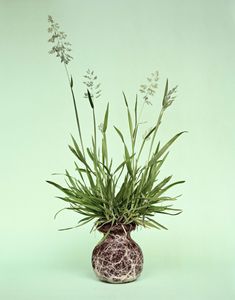
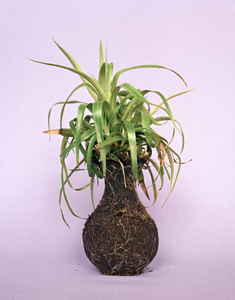
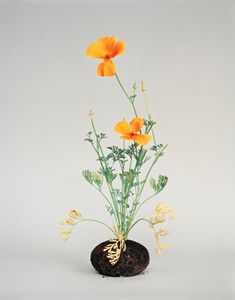
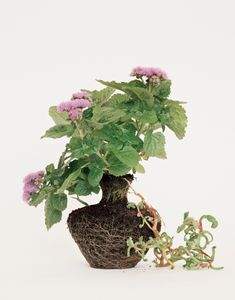
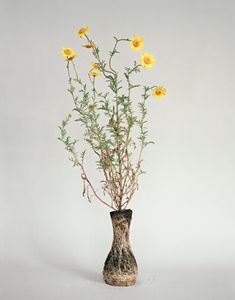
“To collect photographs is to collect the world,” states Susan Sontag in her seminal book, On Photography, while for Diana Scherer, photography itself is “a way to collect”. In the production of her recent series, Nurture Studies (2010–2012), Scherer plays botanist/scientist/photographer/visual artist/collector as she researches, experiments and cultivates her ‘flower pieces’ before organizing, archiving and producing photographs of her work.
The process is painstakingly slow and Scherer’s dedication to her work, both above and below ground, is evident. She started experimenting with plants and flowers, both of which are classified as flora, a couple of years ago with mixed results. “It took three years for me to discover the right working method and I had to try out lots of different flowers. Depending on the flower, I wait until the roots and the blossom are fully developed, which sometimes takes six months but other times just four. Often it doesn’t work out at all and, quite often, I found that the roots were too weak.” Scherer breaks the vase containing the plant the evening before to allow the soil and roots “to dry out a little” before photographing the ‘flower pieces’.
The series of photographs, Nurture Studies, is of cultivated plants, weeds and wild flowers that have been grown from seeds taken from her garden in the Netherlands. “The ambiguous nature of collecting intrigues me,” she says. “It involves loving attention as well as a fanatical desire to control. The collector documents and stores the object of his desire in a systematic and detached way. I also treat and present my work in an objective manner, even though working with nature has an emotional charge for me.”