Qashqai People
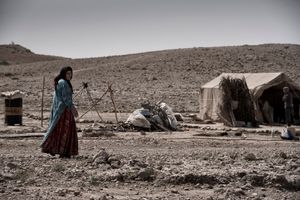
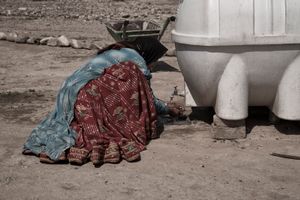
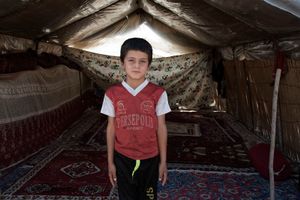
Qashqai People Around Shiraz, Iran Quashqai are a conglomeration of clans of Turkic ethnic origins. For centuries the Fars region had been a multi-ethnic region, in which tribal and pastoral nomadic groups composed a large part of the population. They mainly live in the Iranian provinces of Fars, Khuzestan, Kohgiluyeh and Boyer-Ahmad Province, Chaharmahal and Bakhtiari Province, Bushehr and southern Isfahan, especially around the city of Shiraz and Firuzabad in Fars. After assimilation politics since Pahlavi, almost all of them are bilingual, speaking the Qashqai language - which is a member of the Turkic family of languages and which they call Turki — as well as (in formal use) the Persian language. The majority of Qashqai people were originally nomadic pastoralists and some remain so today. The traditional nomadic Qashqai travelled with their flocks each year from the summer highland pastures north of Shiraz roughly 480 km or 300 miles south to the winter pastures on lower (and warmer) lands near the Persian Gulf, to the southwest of Shiraz. The majority, however, have now become partially or wholly sedentary. The trend towards settlement has been increasing markedly since the 1960s. The yearly migrations of the Kashkai, seeking fresh pastures, drive them from the south to the north, where they move to their summer quarters "Yailaq" in the high mountains; and from the north to the south, to their winter quarters, "Qishlaq". In summer, the Kashkai flocks graze on the slopes of the Kuh-e’-Dinar; a group of mountains from 12,000 to 15,000 feet, that are part of the Zagros chain. In autumn the Kashkai break camp, and by stages leave the highlands. They winter in the warmer regions near Firuzabad, Kazerun, Jerre’, Farashband, on the banks of the river Mound, till, in April, they start once more on their yearly trek. The migration is organised and controlled by the Kashkai Chief. The Tribes carefully avoid villages and towns such as Shiraz and Isfahan, lest their flocks, estimated at seven million head, might cause serious damage. The annual migration is the largest of any Persian tribe. The Qashqai were a significant political force in Iran during the late 19th and early 20th centuries. Few years many Qashqais had settled. Most of the tribal leaders were sent to exile. After the Iranian Revolution of 1979 the living leader, Khosrow Khan Qashqai, returned to Iran from exile in the United States and Germany. He was soon arrested and executed publicly in Shiraz in 1982 for promoting an uprising against the government. Sedentarization of Qashqai nomads, and rise in their involvement in non- pastoral and new economic activities, has intensified since the nineteen sixties. Presently, the Qashqai form mainly settled and semi- settled households. Settled Qashqai are dispersed throughout the region, but mostly in rural and urban locations in north-, mid-, and south-central Fars. There are some Qashqai who reside outside southern Iran, and indeed throughout the global village. With the dissolution and transformation of tribal hierarchies and groupings in the last few decades, the importance of social than silk, and makes one think of translucent enamel". Qashqai carpets have been said to be "probably the most famous of all Persian tribal weavings". Qashqai saddlebags, adorned with colorful geometric designs, networks in the way Qashqai construct their daily lives has increased. Transformations of the last few decades have brought new channels of establishing networks in urban areas and in the state apparatus. Qashqai population of today is estimated to be over Two millions. The definition of who could be, or is considered Qashqai, is contextual, multiple, and variable in time and space. This estimate is based on a more inclusive definition. There are no “reliable” statistics on the changing divisions into settled, nomadic and semi-nomadic components.
No categories selected
Photos (10)