Granitsa

Photos (26)

Houses and offices in the centre of Narva.
File: Granitsa_SooSChronicles01.JPG
Cover
Ljubov Zvereva is the head of the most important association in Narva gathering disabled people and war wounded of the Russian community. The association helps them in finding an occupation and in the everyday life activities, Narva.
File: Granitsa_SooSChronicles02.JPG
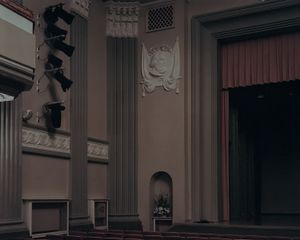
The theatre inside the Sillamäe Cultural Centre, one of the brightest and best kept example of the Stalinist architecture of the city.
File: Granitsa_SooSChronicles03.JPG
Narva, Estonia.
File: Granitsa_SooSChronicles04.JPG
Jelena Shestak is a teacher of Estonian language in the Narva High School. Besides the teaching in the school, Jelena gives lectures and private lessons to Russophones who want to take the language proficiency exam required for Estonian citizenship.
File: Granitsa_SooSChronicles05.JPG
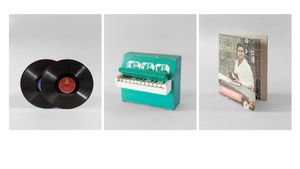
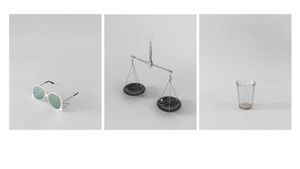
Everyday items found in situ belonging to the Soviet period. They show how deep was the process of Russification, started from the 50s, especially within the people's daily lives.
File: Granitsa_SooSChronicles06.JPG
The Estonian-Russian border from the tower of the Narva castle. In the background the Russian twin city of Ivangorod.
File: Granitsa_SooSChronicles07.JPG
Sergej Tjahin came to Narva looking for a job in 1969 from Chuvashia, a region in the center of European Russia.
File: Granitsa_SooSChronicles08.JPG
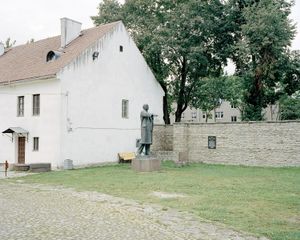
One of the very few statues of Lenin left within the European Union stands today in the courtyard of the Narva castle. The Russian communist revolutionary directs his look to the border, just a few meters away.
File: Granitsa_SooSChronicles09.JPG
Inside the Sillamäe Cultural Centre is hidden a fallout shelter, where today all sorts of items from the Soviet period are kept, together with souvenirs and memorabilia, like this book collecting champions and sport heros of the city.
File: Granitsa_SooSChronicles10.JPG
Everyday items found in situ belonging to the Soviet period. They show how deep was the process of Russification, started from the 50s, especially within the people's daily lives.
File: Granitsa_SooSChronicles11.JPG
Alla Matveeva wearing traditional Russian clothes. Alla is the director of Svätogor, one of the slavic cultural centres of Narva, which has the aim of spreading and preserving the Russian traditions in the Ida-Viru county.
File: Granitsa_SooSChronicles12.JPG
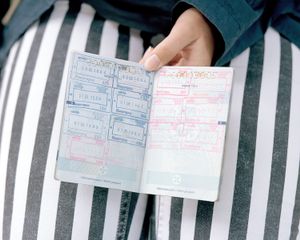
A grey passport, the one for stateless persons, grants anyway access to Russia and a maximum of 90 days of stay.
File: Granitsa_SooSChronicles13.JPG
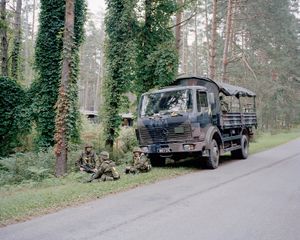
Soldiers of the Estonian Army during military training in the forest. Exercises are held quite often in order to keep the Army ready to defend the country from an attack by Russia, Uusküla.
File: Granitsa_SooSChronicles14.JPG
One of the few cafés in Narva. Its twin city, Ivangorod , lies seamlessly after the border with Russia.
File: Granitsa_SooSChronicles15.JPG
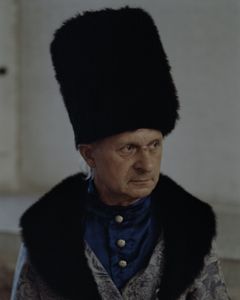
A Russian actor of the Svätogor company before the beginning of a show.
File: Granitsa_SooSChronicles16.JPG
Everyday items found in situ belonging to the Soviet period. They show how deep was the process of Russification, started from the 50s, especially within the people's daily lives.
File: Granitsa_SooSChronicles17.JPG
Overlooking the Baltic Sea, the city of Sillamäe has been an important industrial centre of the former U.S.S.R., producingmilitary hardware and in particular in the uranium processing field. The whole industrial activity was kept under military secret and Sillamäe remained a closed town until the independence of Estonia in 1991.
File: Granitsa_SooSChronicles18.JPG
Sillamäe, Estonia.
File: Granitsa_SooSChronicles19.JPG
Zoya Nikolaeva has worked in the Kreenholm textile factory of Narva (the biggest one of the city) until the collapse of the U.S.S.R. and the consequent closing down of the business.
File: Granitsa_SooSChronicles20.JPG
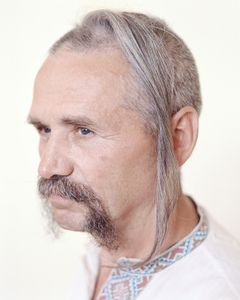
Borys Tutuka proudly claims his Ukrainian origin. Ukrainian people were transferred to Estonia during the Soviet period and today they are the second biggest Russophone minority of the country, Kohtla-Järve.
File: Granitsa_SooSChronicles21.JPG
Everyday items found in situ belonging to the Soviet period. They show how deep was the process of Russification, started from the 50s, especially within the people's daily lives.
File: Granitsa_SooSChronicles22.JPG
The Estonian-Russian border crosses the Baltic Sea, north of the touristic town of Narva-Jõesuu. The area has long been a popular summer destination, especially during the Soviet period, when it was visited in large numbers by representatives of the Russian intelligentsia and local people.
File: Granitsa_SooSChronicles23.JPG
Albina Pugatsenko inside the meeting room of the Russian cultural organization Nadezda, the biggest in Narva. She is the President of the association.
File: Granitsa_SooSChronicles24.JPG
A tomb of a soviet soldier in the Narva cemetery.
File: Granitsa_SooSChronicles25.JPG
Everyday items found in situ belonging to the Soviet period. They show how deep was the process of Russification, started from the 50s, especially within the people's daily lives.
File: Granitsa_SooSChronicles26.JPG