There are different categories of works of art.
Some rejoice un by their beauty, their sense, the pleasure they bring us. Others make us uncomfortable, mistreat and plunge us into reflection. This series is to be classified in the second category. There are things that we do not want to see but that we have to go through like an exorcism. One must see to understand. Art gives life to these experiences without judging them.
As always with this type of photos, we become voyeurs and imagination is free. Anne-laure J. is immodest. With this series, we return to the innermost of his psyche in the depths of her fantasies. Like surrealists or psychoanalysis, we are witnessing the projection of his subconscious through emotion, technique and narration.
The artist invites us into her world in an intrusive way. The first sensation is embarrassment.
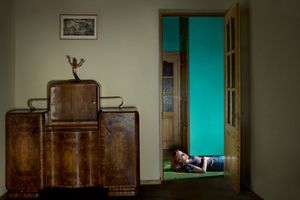
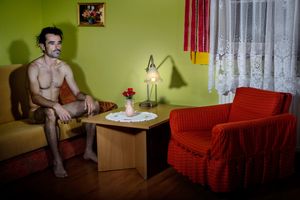
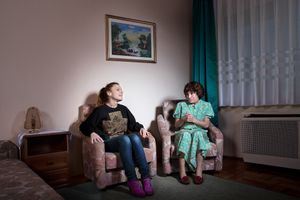
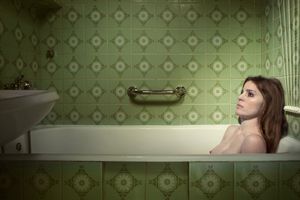
We are the witnesses of indoor scenes between several characters, probably a family. They are heavy, tense. Scenes expose ourselves to windows as fragments of life. They represent a message. Each character and each object has a sens, an identity of its own. Only their position, their attitude, their presence testify of a narration. The atmosphere, defined by light, colors and expressions of faces, gives to the characters a ghostly texture. We imagine stories, emergencies, and dreams. But the more one seeks, the more one raises, the more the meaning is concealed.
It’s the scenography that is the mediator of the story that one surprises as a voyeur.
Constructed, deconstructed and then reconstructed by sedimentation, Anne-laure J. gives us the experience of an interior world as the painter returns to his canvas with an oil whose transparency becomes visible, like the deposit of wine on glass, like a perturbed Vermeer. Anne-laure J. delivers to the film a reflexive work on the unconscious, highlighted by a staging programmed by "successive layers", in mirror and by foam. The walls, the furniture, the objects sweat the emotion that the characters struggle to incarnate. Anne-laure J. is influenced by the disturbing universe of David Lynch which gives to cross the borders of the unconscious.
In most of the images, Anne-laure J. is the subject of the photograph and has been staged as in the works of Cindy Sherman but she is incarnated in a shifted, uncomfortable and personal narrative. She is an apparition sometimes juvenile, sometimes grimaced, with make-up and aged. For in a form of schizophrenia, more or less assumed, she goes as far as to take on the role of a mother. Like Louise Bourgeois, the artist finds the mother through her works. But the ideal universe is that of psychoanalysis, and more precisely the vision of Jung in relation to the archetype of the destructive Great Mother. It is this therapeutic aspect which gives the true thickness to the story. Anne-laure J. represents her alone with her youth, sometimes associated with a mature woman and now with a man. The presence of this man is remarked by break-in. Is it a man-father, a father-in-law, a lover?
Misunderstanding is omnipresent. This results in violence. Violence on several levels. Violence of human relationships, aging bodies, immodest nudity or more widely violence of life. In few images, Anne-laure J. makes us feare the worst violence and disrupted us again.
When Anne-laure J. is not alone in the picture, she is still alone ... Is the artist the work? The mirror is at the heart of the device and that is why we can not get out of this experience without being disturbed. If this uneasiness exists, it is because we understand its meaning and its essence. This shows the necessity for Anne-laure J. to do this work and the necessity for us to see it.