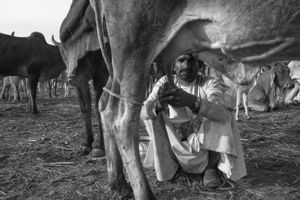
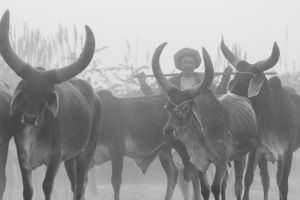
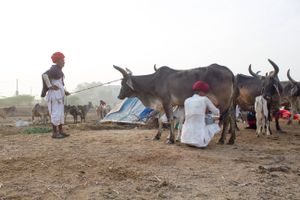
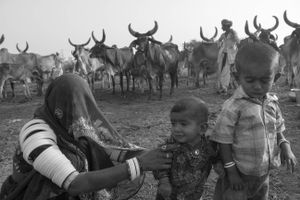
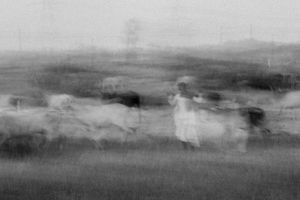
This submission evolves from roads of India. I used to frequently travel on NH 10 (National Highway No.10) where I often saw large herds of cattle led by bright red colour turbaned men. Prior to this my only introduction to Raikas was through pictures on internet. A photo essay assignment was the first instance where I thought of interacting and documenting their livelihood. Raikas/Rabari have a simple life strategy of nomadic pastoralists who travel over the land with their cattle. Their interactions with the local or host communities have changed a lot from the past where they provided animal husbandry related services to the settled agriculturists in these lands. It appears that access to land, whether cropped or waste is crucial to Raika for continuing their livelihood. It may be noted that in the present times every inch of arable land is used for cultivating especially in the states with largely agrarian demographic. In this context, a nomadic-pastoral livelihoodstrategy requires careful planning and a deep knowledge both of land and its people. During my interactions while preparing the photo essay I got to know more about the community and their way of life. As I myself belong to a community which is largely agrarian, some of the Raika strategies fell into the category of common sense. However, there were certain facets which were unique to them. For example, every cow in the herd, whose size often ranged to 500 heads, had a name and the animal responded to the calls of the handler. Raikas, rarely use the modern medicine system and largely rely on traditional knowledge for treating their cattle. It was normal to see to a Raika herder carrying a calf, born barely some hours ago, on his shoulders and the mother following the handler to the camp. The animals were also intensely protective of their handler and it was impossible to evade their attention in case one decided to talk to a herder outside of the camp.Animals in a herd have deep trust for their handler and this allows the herder to navigate highways, streets and residential areas with ease. Raikas stay in a camp for 4-5 days and take the herd for grazing in the nearby areas. The herd returns to camp in evening. Cattle is milked twice a day, one before taking the herd out in the morning and once in the evening after the herd returns from grazing. Young and weak animals are left behind in the camp in the care of young men who were still learning the art of herding.
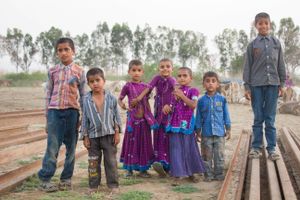
Camps are rudimentary with only tarpaulin serving as roof. They have low dependence on electricity though mobile phones are increasingly used. Children in the camp and women also live a hard life arranging for firewood, water and other needs of the camp. Raika’s livelihood has a hint of medieval on the surface and it is easy to romanticise the community. Yet at a very basic level this livelihood stems out from a necessity and for this reason Raika’ssuffer in terms of education, healthcare and other amenities. Hostile behaviour by other communities, harassment faced by women and children and cattle theft is some of the causes which are forcing the Raikas to adopt alternatives to a pastoralist livelihood. This fact is evident from the dwindling number of young people in the practice.
My photographs of Raika’s revolve around the theme of landscape and its use as a space. I see Raika’s as people who are in certain ways alien and different to communities in which they traverse for their livelihood. Yet they face a future where the spaces crucial for their existence would be reduced to a minimum. My motive for this documentation is no doubt directed by a sense of romanticism of the past peoples but it is also based on the human desire for outdoors along with the aspects of modernity which change the way we live and engage with nature.