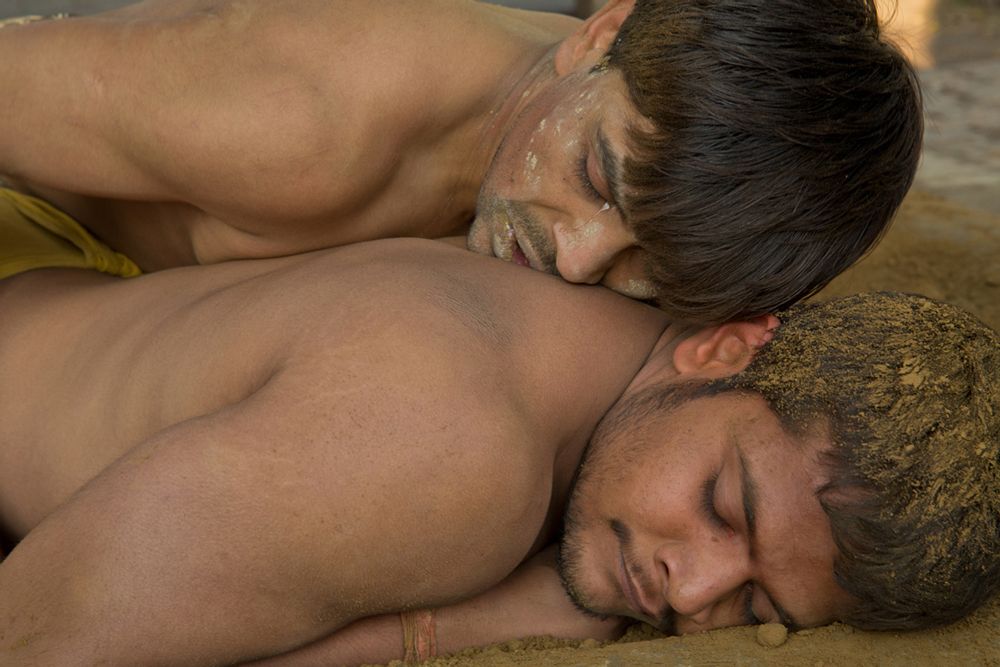
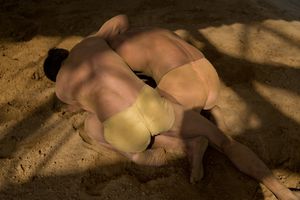
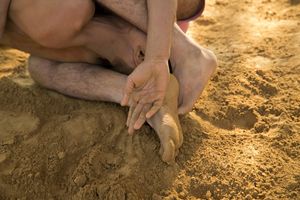
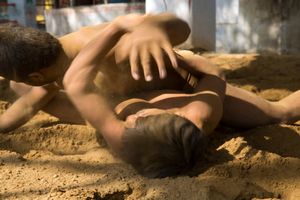
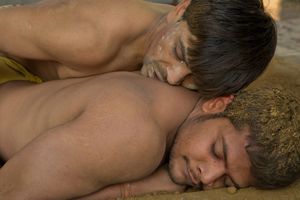
The fifth chapter “Varanasi” investigates Indian mud wrestling or mitti kushti. Wrestling in India, and particularly in Varanasi, goes back to ancient times. A certain form of wrestling was practiced before the one brought by the Mughals in the eleventh century: Bharatiya kushti (Indian wrestling) or simply kushti, as it is called.
In this country where religion impregnates each act of everyday life, kushti has blurred the religious borders, just as music has done. Even though the Mughals brought it as a strong print of their identity, Hindus adapted to it by introducing religious rituals into it and dedicating the sport to the deities of their pantheon.
Indian wrestling is also a way of ascetic living, implying not only intensive physical training, but also a code of ethics, personal hygiene and specific diet, celibacy, sexual abstinence, devotion, discipline and a multitude of other moral values. This unique sport requires a balancing of the body and spirit - it is a worship offered to the deepest human values, to the world of gods, to an ideal. Kushti, has something to do with the search of the ideal, a harmony between human beings and gods.
The daily training takes place in an arena called akhara. A guruji directs an akhara, dictates its rules. He is the backbone of the place. He defines the objectives and sanctions if they are needed. In addition to his role as coach, he is the leader of the akhara.
The images were taken at the Akhara Bara Ganesha in Varanasi. Mitti kushti is a sport that is heavily rooted in Hinduism and its values. What makes this akhara special is that Hindu and Muslim men can train and fight at Bara Ganesha. Only a few akharas welcome Muslim fighters.
This chapter also has a video piece.