It`s WHITE...I
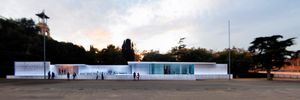
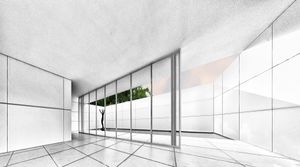
For a few days of November 2017, by the way, at the gates of the centenary of another major work of contemporary art - white square on a white background by Kazimir Malévitch - the reconstructed German Pavilion at the Expo of the 29th presented an appearance that, in the eyes of the spectators as well as the experts, has turned out to be a kind of irreverent exercise, as was left by its authors, the young architects Anna & Eugeni Bach in a recent conference in Barcelona. It is true, where they were stainless steel, the green marble of the Alps, the Golden Atlas of the onix, the Roman travertine, the black mat, the red curtains and the very comfortable Barcelona chairs that Mies himself designed for the occasion ... ?. It is true that the whole building, except glass, was covered with a white vinyl, a kind of laminated patina with a shade that would have blurred the characteristic expression of the work, now undressed of all attributes granted to it Materiality has been shown to us by an ephemeral time as it was transferred to the moment of its conception by the architect, at that time where there were no computers and having to draw the projects on paper, there was the process of designing this state that we have now been able to enjoy, expressed that using it might run-run by the aforementioned, but I also attach myself to this PROVOCATION, if the master in large capitals and in bold, that Mies Missing Materiality , as this is called this intervention and that has allowed us to live together with unforgettable moments with this much more conceptual space and dispossessed of the paraphernalia or make-up that presents the work that we normally face, dematerialization , which incidentally is not alienated to Mies's work as it reached America, once the old Europe was left, it was the resource that, with all due diligence, traces the thread of the Fansworht house in Illinois, where volumes become weightless and the almost unlimited space is subtly outlined through a simple referential try. Let us take advantage of these moments where the Barcelona building of the 1929th presents us with white and radiant in this performance that takes us to that process of designing the architecture where seeing and playing was the way of perceiving and this is where we can experiment with that work In the conception of his space, he initially materialized in the models and that in the case that we are dealing with, we have the dream scale 1: 1, that is, we have the world on a real scale and without reducing ...! So welcome is this invitation that travels on the threshold of suggesting, since we are too accustomed to pontificate. I have to warn you that these photographs made in open hours to the public and that appear in a standart format have not been done with just one click and I invite you to do them and if the pavilion does not show the image of those moments, the walls continue to stand on the site at the time of making these images, which project shows this "discover" the continuous appreciation - the space of this small building, icon of contemporary architecture, which has two courtyards and a room, An itinerary that goes from the outside while it fluctuates between everything and the part until it reaches the merger between the viewer and the place after the de-dimensionalization.
No categories selected
Photos (12)