
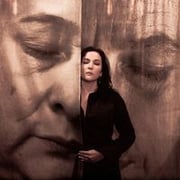
Silencios / Silences
Another Look at the Holocaust The photograph shows the face of a woman in her seventies, whose features still keep the likeness of what once was an extraordinarily beautiful youth. The hair style, the makeup and the unpretentious necklace around her neck denotes a person who gingerly takes care of her appearance. The viewer has the impression that life has been good to her. Nevertheless, the look in her eyes betrays an endless sadness. Another photo just shows the lap of the woman. In her hand she holds an open book where the pictures of two young women can be seen. They are this woman and her older sister many years ago. Etka and Anya, those are the names of the two sisters, suffered the monstrosity of a concentration camp on their own soul and flesh. It so happens that they are relatives of mine. Specifically, they are my father’s first degree cousins. My grandfather on my mother’s side located them after the war and took care of the procedures to bring them to Colombia, where he had lived since 1925. Etka got married, started a family in Bogota, and years later moved to Mexico. When Anya arrived, she was married to a good man who had lost his wife and children in Auschwitz. They were unable to have their own progeny. They lived in Barranquilla for many years, and then they moved to Miami, where their remains rest today. My aunts Etka and Anya became my first Holocaust reference in a direct and realistic way. I remember that, as a child, I would examine them with curiosity, trying to find traces of the tragedy in their gestures, their attitudes and their silences, but what I found was two sweet, affectionate, active ladies who were always ready to celebrate good times with the family. I noticed some sadness in the expression of their eyes, but my childhood naïveté could not perceive that such an expression of sadness could be the manifestation of the amount of atrocities they had endured. The photographs of Etka’s face and arm are samples of the exhibit “Silences”, an ambitious project that the photographer Erika Diettes has presented to the public to bear testimony to those Jewish men and women that, through diverse circumstances, arrived in Colombia after having suffered Hitler’s barbarity. It was not an easy job. Diettes had to carry out almost detective work in order to find the few that are still alive, and in the process, she found out that some of them do not reside in the country anymore. A lot has been said about the genocide in which two thirds of the Jewish people died. Way less is known about the lives that those who survived led afterward in the countries that fostered them. In that sense, Diettes’ work has testimonial worth that goes much further than any consideration about her photographic undertaking, which is by all means excellent. Diettes does not resort to easy sentimentality nor to appalling images in order to meet her objective; instead she uses a simple but. forceful formula: a close up photograph of the survivor and a second picture of the person’s arm holding some symbolic object. At times the tattooed Auschwitz number is visible. In some cases, there is a third photograph with a testimonial note written by the photographed. All the men and women that agreed to pose for Diettes have something in common: that look full of serene sadness that I always saw in my aunts Etka and Anya, even when they laughed. Those are looks that seem to say, “I experienced a kind of horror that none of you has ever lived and will never understand.” To be a survivor is never easy. It is way less easy when you have survived the paradigm of horror itself. We tend to perceive the survivor as a fortunate being that has managed to overcome a catastrophe, without stopping to think about the psychological burden that the person will bear all through life, not only due to the terrible experienced endured, but, even worse, due to the feeling of guilt that will hunt him or her for having been saved. When the allied armies walked victoriously into the concentration camps, they flooded the world with propagandist pictures that showed their soldiers as liberators fallen from heaven into a terrifying scenario where some skeletal bodies that could hardly keep on their feet roamed around like ghosts. In reality, the famous liberators were late: six million Jews had already died before the indifference of the world. Further more, the survivors were dead in life and had lost everything: loved ones, home, country. To start a new life was anything but easy for them. Even in Israel, the survivors were treated in a somewhat cold fashion that bordered despite at the beginning. The trend among the Israelis, in those epic days of the creation of the State, was to extol the most notorious acts of resistance against the Nazis. Radio and newspapers praised the heroes of the Warsaw ghetto uprising, or the protagonists of one or another revolt inside the concentrations camps, or the militant Jews that belonged to partisan groups. There was an implicit rebuke for those who lacked a heroic deed to show. This environment precluded from a dignified position all those survivors −the immense majority− whose only act of resistance was to walk out of hell alive. In his book The Garden of the Just, the Italian journalist Gabriele Nissim tells that Judge Moshe Bejski −the same that revealed the existence of Oskar Schindler− hid his condition as Holocaust survivor for years and pretended to be a born “sabra” among his associates because he thought this was the only way to build up a future in Israel’s society. It was during the trial against Nazi hierarch Adolf Eichmann, which took place in 1961 in Jerusalem, that everything changed. Throughout the trial, several witnesses, including Bejski, succeeded in making the peoples of the world realize that a minority equipped with enough coercive tools and plenty of evil can submit an unarmed majority, which does not means that such a majority deserves to be named coward or that they allowed themselves to be driven to the slaughter house like a herd of sheep. These witnesses explained that some alleged acts of courage, such as running away from a concentration camp or murdering a camp guardian, automatically provoked cruel retaliation against the rest of the interns. They spoke about their struggle to preserve dignity within that grey zone of degradations that Primo Levi described so masterfully. In short, they managed to demonstrate that, in the survivors’ mere individual resistance to humiliation and death, there also was a high dose of heroism. Today, we can see some of these heroes’ faces thanks to Erika Diettes’ lucid gaze. Marco Schwartz
No categories selected
Photos (90)


