The legendary historical event of the 47 Ronin was romanticised and transformed into a propaganda film commissioned by the Japanese Imperial government as an example of ultimate loyalty to the state. It subtly facilitated the transformation of a symbol into one of mass killing, without provoking people to whom the transformation of meaning is not apparent.
The Samurai Code of Conduct we know now is an idealised imagining of Japan’s culture and past, a glorified past that never truly existed, brought upon by a writer called Inazo Nitobe in 1900. His depiction was embraced and exploited by the government driven war machine, paving Japan’s way to fascism in the buildup to WWII that led to the deaths of millions.
Working with notions of filtering and distortion (key characteristics of propaganda), I examined images of atrocities committed by the Japanese during the war with an inspection camera, a tool that helps one to inspect those hard to reach places such as sink pipes. I had accidentally discovered it through my pastime of cleaning. Its limited focal distance of 3 to 6cm, combined with a low resolution of 2 megapixels and the blue light emitted by the retina screen, elicits an abstract and obscure form of imagery, where the once clearly defined photograph is reduced into random, alluring blocks of shapes and colours. Even when it is aligned properly, the camera produces a varying degree of keystone effect, adding on to the abstractness of the image.
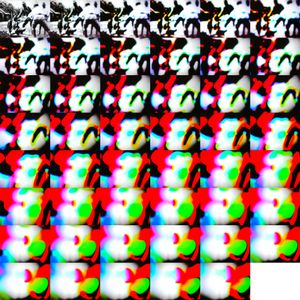
With the above in mind, I decided to power the technology of the camera to highlight how the meaning of anything can be endlessly interpreted by rephotographing 47 images of atrocities 47 times each. The first photo is a rephotograph of the original; the second photo is a rephotograph of the first photo; the third photo is a rephotograph of the second photo; so on and so forth.
The end result of each image is one that is physically the same distance, ontologically further away and yet visually nearer. The original photo and the final image sort of cancel each other out, redefining the representational nature of photography. It appears that the final image has a boiled down aesthetic, where the original photo paradoxically undergoes “evaporation” and “accretion” at the same time.
Due to the repetitive characteristic of the rephotographing process, the images produced are of a systematic abstraction and yet, within the overall framework, the variations are infinite and indefinable. The images are then presented in a grid that shows the transformation process from the original photo to the final image.