Sara Angelucci
Piece Work
Essay by Alana Traficante
Acting Curator of Contemporary Art, Art Gallery of Hamilton
Sara Angelucci has long engaged her practice in topics of memory, anonymity, and identity. With this latest body of work, she considers the lived experiences of workers in Hamilton’s apparel industry – the majority of whom are immigrant women – as windows to the layered and diverse perspectives of our multifaceted community. Angelucci conveys this intricacy in a composite installation of photography, video, sculpture, and sound: crafting a multi-sensory environment that is informed, in part, by her own familial history.
Angelucci was born in Hamilton to Italian-immigrant parents who, upon their arrival in the 1950s, were both employed in the city’s thriving industrial sector. Her father Orfeo was a steelworker at Stelco, and her mother Nina, a garment worker at Coppley Apparel, a
longstanding suit factory in the heart of downtown. Their experiences of migration and settlement, their work and personal identities have continually informed Sara’s creative practice. From her position as a second-generation Canadian artist, Angelucci works with a
range of media to explore the resonant power of embodied memories, while remaining deeply attentive to the material, cultural, and social contexts from which these memories emerge.
In 2016, Angelucci first visited the Coppley factory to piece together a greater understanding of her mother’s personal history. She learned that Coppley has operated in the same white stone building on York Boulevard since 1883, and has employed every wave of new
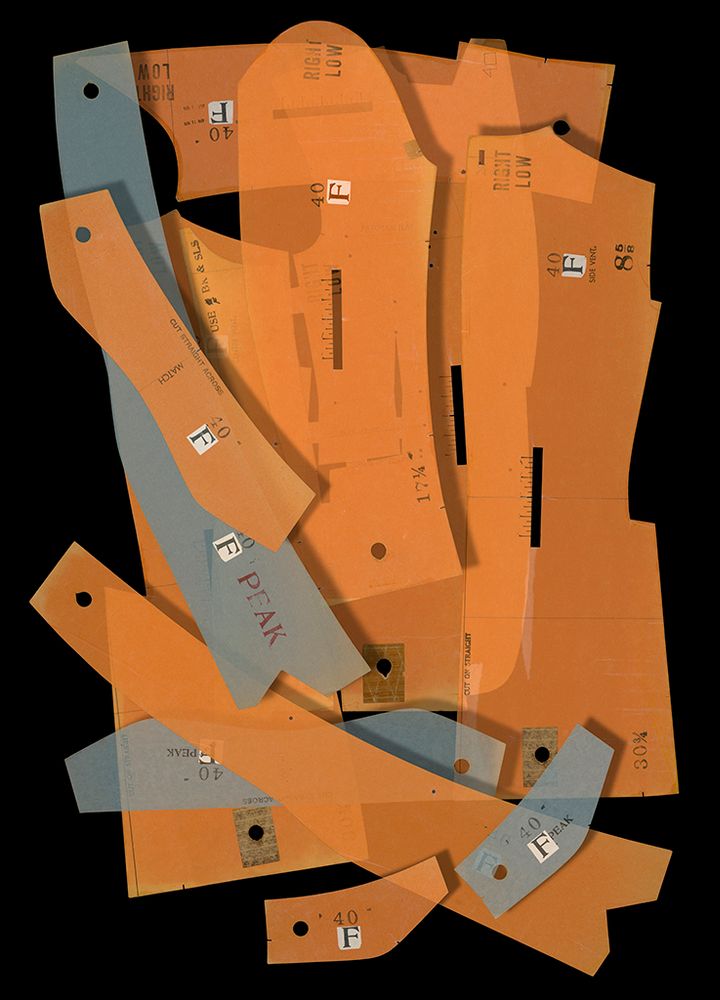
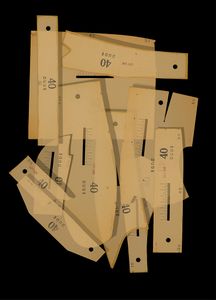
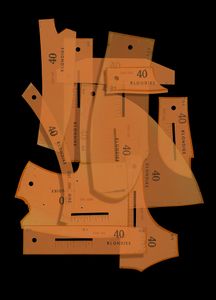
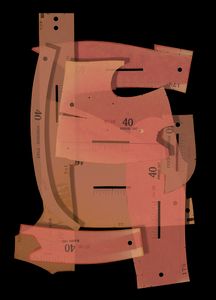
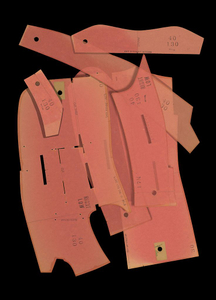
immigrants to the city. In 1957, alongside many other European immigrants, Angelucci’s mother began her first paying job in the factory’s pants department; she sewed piecework (paid by the number of pieces she completed each day), and hers were just two of many hands that contributed to the cutting, sewing, and pressing of each finished suit. Today, Coppley’s production model is very much the same: there are 123 pieces required in the construction of
a man’s suit; the majority workforce is still female; many workers are older European immigrants, while others are recent newcomers to Canada; and over 30 languages are spoken on the factory floor. And while these 300 garment workers remain largely unseen, the products
of their combined labour – the suits themselves – continue to convey a carefully constructed image of successful Western masculinity.
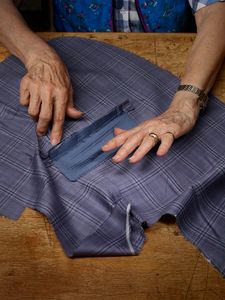
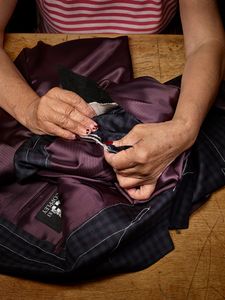
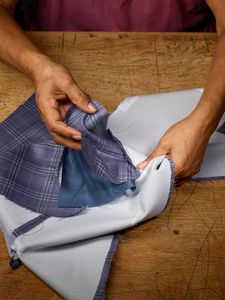
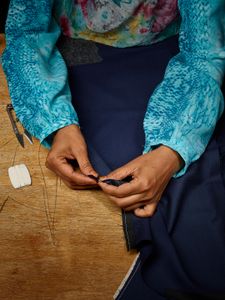
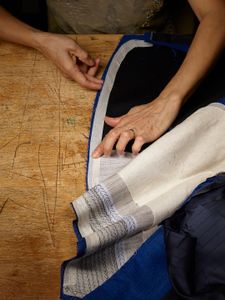
Through the welcoming support of Coppley, Angelucci initiated this new body of work on site at the factory, collaborating with current-day garment workers. Angelucci’s exploration is twofold. First, she bears witness to the ways in which the body learns acts of labour.
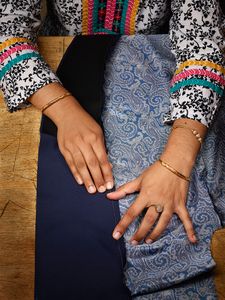
Interrogating the specific, fragmented nature of piecework, she makes visible processes of muscle memory and the skilful relationships that develop between workers and their materials. However, Angelucci also reveals that while identity may be formed in part by the work we do, experiences of labour are also personally and culturally informed. Inviting sewers to share their stories, the life of work becomes steeped with intimate memories; trauma; the presence and absence of loved ones; dreams, disappointments, and achievements. With these myriad
elements, Angelucci strives to break our assumptions around immigrants and their labour. She presents the person, alongside the profession, as two parts of a whole. Together, this fulsome
perspective may help build the necessary armature to navigate and expand our understanding of a complex, and ever-changing world.