Marco Benedetti / Japanese Legends
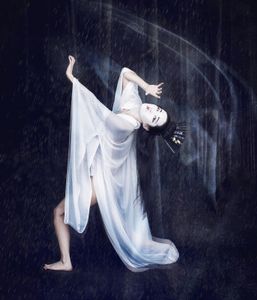
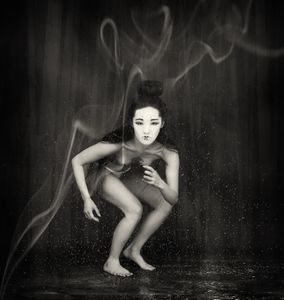
Hannya (般若) Due to ancient Japanese Legend, Hannya refers to demons, more specifically to female demons who were called Kijo or Kijo witches who are also interpreted in the Noh theatre plays. These women were once human before being completely consumed by jealousy and psychically transformed into demons. The word Hannya is also used to refer to a demon mask used in Noh theater. The Hannya exist in several forms: Namanari, Chūnari and Honnari. The Namanari Hannya are Kijo, strange mythical creatures (ogres, demons) looking like human women. Normally they have small horns and use black magic to accomplish their demonic acts. The Namanari Hannya are not completely evil, this means they still have a chance to become human. The Chūnari Hannya are much more accomplished demons. They have long, sharp horns, teeth shaped like elephant tusks and use a very evil black magic. Nevertheless, they are vulnerable to the prayers of Buddhist monks. The Honnari Hannya are real demons having reached the final stage of the complete metamorphosis. These women have a body like a snake demon and spit fire. Their jealousy was so deep that nothing more could calm their anger and fury. Concept For this series, the Butoh dancer interprets a Namanari Hannya. She fights hard against the demons haunting herself, demons disrupting her continuously between the real and the demonic world. Sometimes she succeeds, sometimes the demons take over and win the fight. Abstractly, the loss of self-control is illustrated by nudity, a sign that the demons of jealousy win ripping off everything Hannya owns. Kamaitachi (鎌鼬 - かまいたち) The Kamaitachi is a Japanese Yokai. A Yokai is a ghost, a strange wraith. It is a supernatural monster. These creatures are the source of strange events, they appear often riding dust devils, their nails are sharper than razor blades and chop all persons they find on their way. These cuts create very serious injuries which, strangely, do not produce pain. The legend tells these creatures were looking like ghosts with a weasel head and report that children playing in the old Edo (ancient name for Tokyo) have been wrapped by a powerful wind swirling like a tornado. After the passage of this evil wind, the backs of the children remained deeply marked, all bearing the footprints of the monstrous beast. This supernatural monster had a fur similar to that of a hedgehog and screamed like a wild dog. Moreover, the monster flew through the air with its impressive and huge wings, and with its sharp body parts attacked everyone within its path. Concept For this series, the Butoh dancer had to be fully inspired by the spirit of Kamaitachi, trying to feel the strong and cutting wind. She was going through the deep forest she was suddenly caught by a swirling wind, powerful like a tornado, inflicting blows and deep cuts all over her body. As she did not feel the pain of the wounds she tried to continue along the forest path to escape Kamaitachi. This series required a perfect osmosis between the dancer and the photographer; moreover an assistant was responsible for recreating the similar atmosphere like the Kamaitachi wind. Butoh The Japanese term Butoh (舞 踏) is composed of two ideograms; first, bu means "dance" and the second tō, "tap on the ground". Butoh is a form of Japanese contemporary dance, created in the late 1950s by Tatsumi Hijikata (1928-1986). Hijikata is the founder of Ankoku Butoh (暗 黒 舞 踏) meaning "dance of darkness" which combines a dance choreography with elements of traditional Japanese theater. German Expressionism, the "Neuer Tanz", also influenced Butoh. The Butoh dancer must be able to improvise constantly. The dancer's body is often painted in white, the movements are often slow and contortionists. Butoh is a kind of rebellion against any kind of prefabricated culture, declined from the modern society, society that wanted the body to be an instrument totally shaped according to predefined rules. In Butoh, the body is presented as a living and evolving sculpture, shaped by every day’s life, a body containing also the experience and the intimate history of any person.
No categories selected
Photos (10)