Notes on the set:
“ A grisaille is a painting executed entirely in shades of grey or of another neutral greyish colour. It is particularly used in large decorative schemes in imitation of sculpture.” – Wikipedia (2018)
I wonder about the description of grisaille technique used “in imitation of sculpture,” but do believe it can bring to representational imagery a less illusionistic rhetoric.
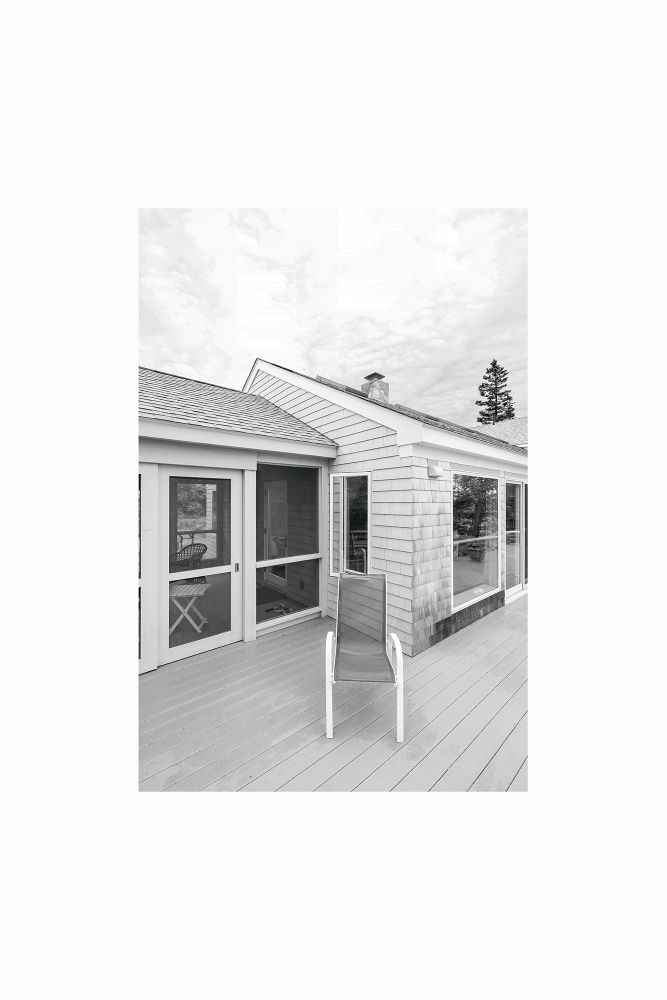
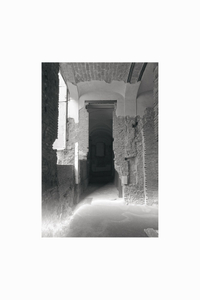
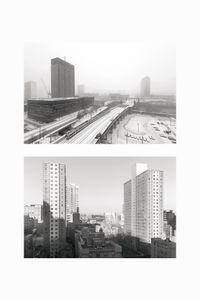
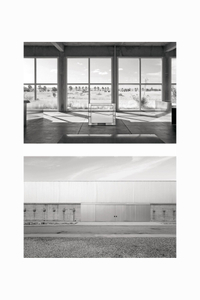
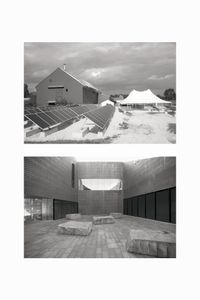
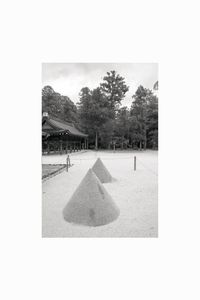
After exploring them initially in color, I worked on developing the mixed images in this set as grayscale images, over the past two years, because I was finding their color dramas to be too limiting – they were obscuring some other dramas in the images, and also impeding the perception of some interesting correlations among the images. When I began selecting the images to include in this grisaille study-set, in 2016, I was looking for ones that would help me continue exploring the kinds of form – or the questions of form – I had become most interested in, after looking at architecture and other designed things such as sculpture, over time, during my life as an architect.
At first, I imagined that the set might turn out to be a collection of illustrations of something like the underlying patterns Christopher Alexander and his associates studied, wrote about, and then partially illustrated in their book "A Pattern Language: Towns, Buildings, Construction."
More recently, I realized that the images I wanted to include in my study-set were not going to be good illustrations of such defined and normative patterns as Alexander’s. They were more ambiguous (not unlike the illustration for Pattern 159). They seemed to represent, individually and collectively, a shifting variety of underlying patterns in play, intertwined with one another, unresolved – at the different levels of composition embedded in the designed things viewed. And there was also a play of different underlying patterns coming out of the composition (and juxtaposition) of the images as images. It was that strange complex of interacting and unresolved patterns in play that was making me want to keep experiencing and exploring the images in the set.
After I had developed most of the individual images in this set, in 2017, I began working on how to arrange them in a good sequence for study. I began with the images in a chronological sequence, and then tried them in a number of alternative sequences and arrays – looking for an arrangement that would allow them to be explored individually and in small groupings, in their diversity and with as little reductive juxtaposition as possible. I found that some juxtapositions and groupings worked better than others, when they continued to trigger the perception of stranger rather than more obvious patterns and correlations.
The 63 images in this “Grisaille 2, Frieze” set are organized in a sequence of 21 mixed-image triplets, which I imagine running frieze-like around the four walls of a viewing space, suspended in an image array without a clear story-line or sequence.