I was working in my studio and thinking I needed a new project, so I cued up ‘Mick Jagger & The Red Devils’ on the turntable and kicked around a few ideas. Nothing really jelled so eventually I put what I had so far on the back burner to let it simmer.
The next day I was back in my studio listening to the Tom Waites’ album ‘Mule Variations’ and Tom started singing ‘What’s He Building?’ – a song about a person obsessed with the reclusive man living across the street and what he was up to.
What’s he doing in there?
What the hell is he building in there?
Now what’s that sound from under the door?
He’s pounding nails into the hardwood floor…
And I swear to god I heard someone moaning low.
And I keep seeing the blue light of a tv show.
What’s he building in there?
What’s he building in there?
We have a right to know…
By the time ‘What’s He Building?’ finished playing I knew I had my project.
Tom Waites’ song about obsessive speculating of the unknown is a compulsion shared by all of us.
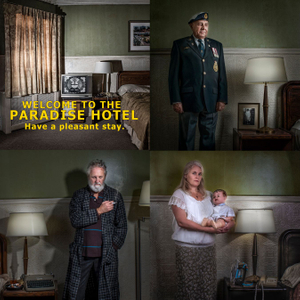
WELCOME TO THE PARADISE HOTEL
Imagine you are passing through town and your car breaks down.
Or maybe you’re here for a job interview or a funeral.
You can’t afford three hundred bucks for a room and even if you could it’s crazy to spend that kind of money… it’s just a place to crash.
So you find a hotel that seems pretty good…it’s not in the best location and it sure isn’t swanky. Some might even call it seedy but for sixty dollars a night, well, beggars can’t be choosers.
The Bellboy is an old man who’s probably worked here since the place was built. He says the elevator is under repair and you have to climb two flights of stairs to the second floor. The old man starts wheezing on the first landing and you know he’s really faking it but you carry your own bag from there.
Your room is at the end of the hall. Halfway there you notice an empty bottle of damn good scotch sitting in front of the door to Room 205. The old man stops, picks up the bottle, unrolls a hundred dollar bill stuffed in the neck and puts it in his shirt pocket.
He says the man in the room is a writer or something. He’s been holed up in there about three months. Confesses he has never seen the guy leave the room. He says you can hear the typewriter clicking if you put your ear up to the door and asks if you want to hear.
You say no thanks, but know you will come back and try when no one is around.
When you get to your room the old Bellboy opens the curtains to show you the view of the alley and what he calls a peek-a-boo view of the skyline.
He says you can’t open the window because it’s nailed shut for safety reasons but doesn’t elaborate and there’s cable on the tv for a dollar a day.
You tip him two bucks.
He gives you a little nod and says ‘Welcome to the Paradise Hotel. Have a pleasant stay’.
After he leaves you wonder how long you should wait before you sneak over to Room 205 and listen at the door, maybe sneak a look through the peephole… because you need to know… ‘What’s he doing in there?’.
THE PROCESS…
It didn’t take long to realize it was impossible to actually shoot the hotel room scenes in a real hotel so I decided to build a set in my home studio. I spent a couple of weeks researching old hotels, working out a colour palette and trying to figure out how I was going to fit the set into my studio and allow enough room to actually shoot it.
It then took me about six weeks to build the room (yes, I did it myself) and another couple of weeks to do the scenic painting and aging breakdown.
I decorated the room with furniture, lamps, etc. purchased from a hotel salvage company.
Finally, I spent several weeks figuring out how to light it and frame it – some of the scenes have eight different lighting sources.
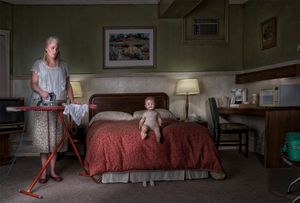
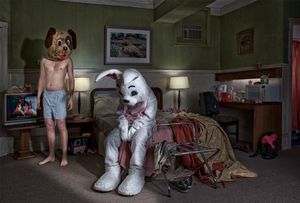
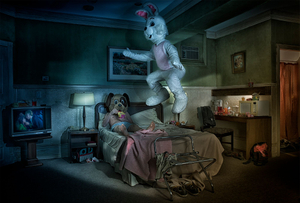
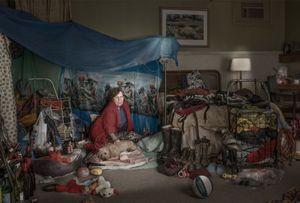
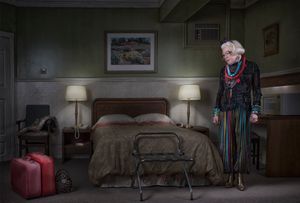
WELCOME TO THE PARADISE HOTEL is now an ongoing project and to date I have created and photographed seven scenes of characters who have stayed at the Paradise Hotel.
Each scene has been conceived using three basic sentence descriptions.
For example:
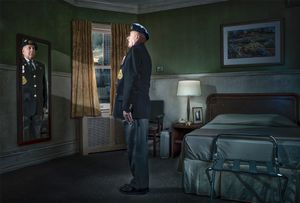
1. An elderly man wearing a military uniform stands at attention in front of a mirror.
2. A framed photograph of a young woman sits on the bedside table. There is and an aluminum case on the floor.
3. The curtains are partially open revealing a bleak, rainy day.
The scenes are then presented to the viewer as stories frozen between moments in time with no further explanation.
I am merely the presenter.
Before, after and now are left as unresolved questions to be answered by you.