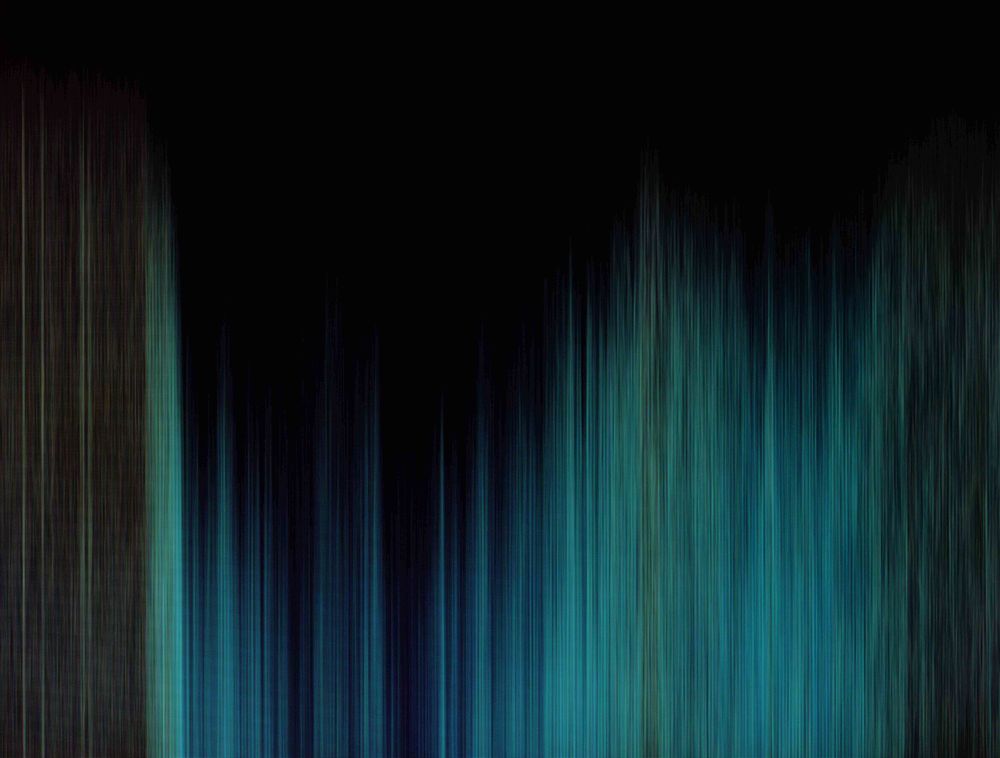
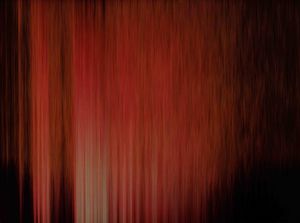
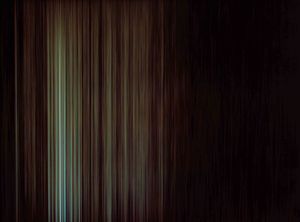
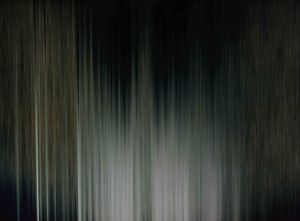
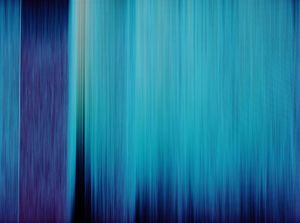
Created over one year at The University of Oxford, these works take as their starting point, audio recordings from thirty six lectures. The lectures span the three academic terms that make up the year - Trinity, Hilary and Michaelmas - and encompass a broad range of academic presentations. From its beginnings, photography’s power to transform has held a fascination. The camera’s ability to reveal, to make visible, to make permanent things which were fleeting or fugitive, was a key part of it’s early success. “The phenomenon … appears to me to partake of the character of the marvellous”, wrote William Henry Fox Talbot in 1839, “almost as much as any fact which physical investigation has yet brought to our knowledge. The most transitory of things, a shadow, the proverbial emblem of all that is fleeting and momentary, may be fettered by the spells of our ‘natural magic’ and may be fixed for ever in the position which it seemed only destined for a single instant to occupy.” Lecture Series explores this notion of transformation, converting sounds into sights, taking transient moments and converting them into static, spatial patterns using a hybrid of technologies. The digital audio files have been made visible through a monitor and subsequently photographed, using a long exposure on a 10x8 film camera. The resulting images use the mediums of both past and present to create a physical marking, a trace in some way, a referent to something ordinarily intangible which has taken place. While there are no claims that they directly picture the mechanisms of another sense, these photographs playfully allude to the transformation of one sense to another, and of one medium to another, reflecting both photography’s shift from analogue to digital and the digitisation of knowledge. The images invite the viewer to consider the technological transformations we are experiencing, the seismic shifts in the systems and structures all around us. Picturing the mechanisms of another sense has long been of interest to artists and scientists, from Ernst Chladni (1756-1827), who perfected a technique to visualise acoustic vibrations in dust known as Chladni’s Figures, to Georgia O’keefe (1887-1986). Her paintings, such as Music- Pink and Blue No 1, (1918) and Blue and Green Music (1919) were directly influenced by the famous synesthete Wassily Kandinsky (1866-1944).
In notebook P, arguably some of his most important writing, William Henry Fox Talbot referred mysteriously to ‘Words of Light’. My hope is that in Lecture Series, you enjoy these lectures in their new form, as ‘Words of Light’.