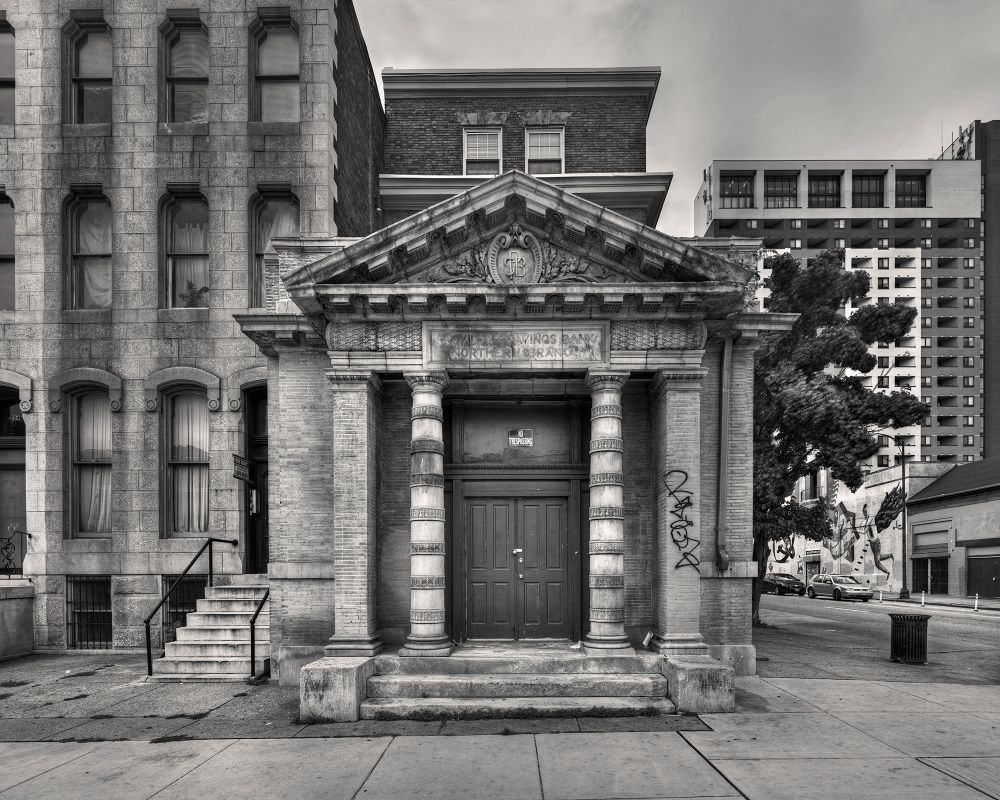
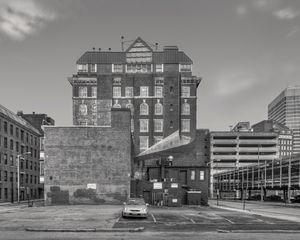
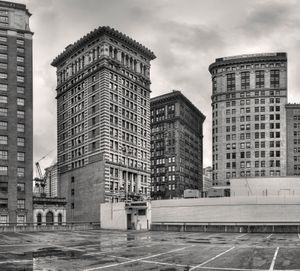
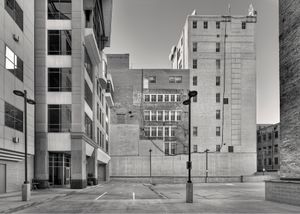
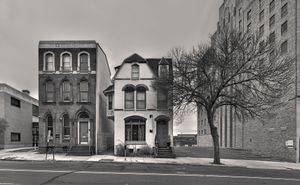
Over the last several years I’ve been photographing late–19th and early–20th century building facades in Rust Belt cities such as Buffalo, Pittsburgh, and Cleveland. This work is part of a longer-term project dealing with the landscape of America’s industrial heartland. The buildings represent a range of architectural styles including Renaissance Revival, Beaux Arts, Art Deco, and early Modernist. They housed institutions and businesses during a period when the Rust Belt cities were at their height of economic and political power. More recently, these communities have struggled to deal with the effects of de-industrialization, diminishing populations, and general urban decline. My goal is to investigate how these buildings, in their stateliness and various degrees of disrepair, engage with the environment of this new urban reality.
So far, I’ve learned a few things about this region — first and foremost, that not all Rust Belt cities are the same. While some, such as Detroit, have suffered a great deal due to the near collapse of a single industry (an industrial/economic mono–culture), other cities have been able to develop new types of enterprises grounded in existing institutions such as hospitals and universities. Pittsburgh, a prime example of the latter, has a thriving downtown area with outer neighborhoods that are stable and livable from a middle class perspective. However, most of the cities I’ve photographed fall between these two extremes, where multiple attempts at revitalization exist in near proximity to structures that are neglected and left to decay. It’s this moment of instability and change in the human ecology of the old industrial city that interests me most. I believe that this is an important time to document these places, and that careful photographic description is a mode that meshes well with the current visual reality, as well as with the long industrial, technological, and design histories of these places.