The Lobby Experience
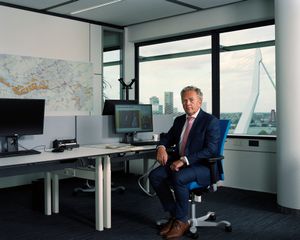
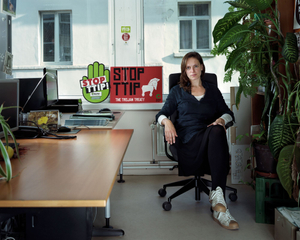
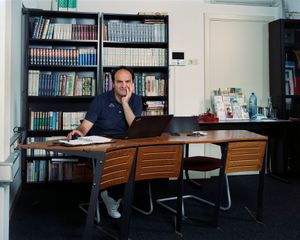
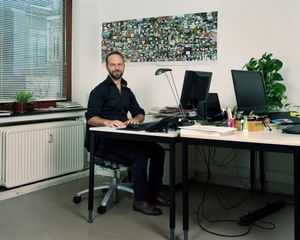
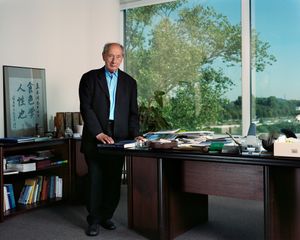
‘The Lobby Experience’ is a multimedia installation that makes a closed and hidden profession visible. One that often operates beyond scrutiny and supervision: the Public Affairs Professional. The Lobby Experience features twenty of these professionals: ten who are active at the Dutch Parliament in The Hague and ten at the EU in Brussels. The Lobby Experience allows the visitor to witness how – and with what arguments – they try to influence important social issues that we all have to deal with on a daily basis. A virtual impression of the installation can be seen in a two-minute video via https://vimeo.com/359296224 Method I portrayed the twenty lobbyists featured in The Lobby Experience in their own workplace and in a classical manner, using a large format (4"x 5") analogue photo camera. In the way I photograph and present the portraits I show them as typologies of Public Affairs Professionals: full length with a lot of attention to their personal work environment, each with a fixed 150 mm lens and photographed at roughly the same distance from the camera. These large prints (100 x 125 cm) make it possible to study the lobbyists as well as their workspaces down to the smallest details. The photo series thus adds a documentary layer to the installation, allowing the viewer to experience more of the personal living environment of the subjects portrayed. Experience Within the inner circle of the multimedia installation I have created an interactive experience where visitors of The Lobby Experience exhibition can find out for themselves what it is like having to consider different views on an issue. Thus, they are being lobbied, as it were. The lobbyists can be seen at work: I filmed them with two cameras while they argued and listened to the arguments of lobbyists from a different segment of society lobbying on the same issue. For each of four issues that were topical in recent years I assembled five lobbyists each of whom represented other interests within these four cases. I filmed them in a studio setting, with one camera to capture their heads and a second camera to film their hands. The lobbyists' hands also communicated their state of mind: relaxed when listening to arguments they agreed with and sometimes clenched into fists with knuckles turning white when they disagreed with the arguments of their opponents. Issues There are four issues that are addressed in The Lobby Experience: the Ban on Non-anaesthetized Slaughter, the Regulation of Lobbying at the Dutch Parliament in The Hague, Genetic Modification of Organisms (GMOs) and the Transatlantic Trade and Investment Partnership (TTIP) in Brussels. Within those issues, I filmed five different perspectives and associated people while they were interviewed by Ireen Oostveen, myself or Caroline Dijk (French-speaking lobbyists). I have analysed these interviews and with excerpts from those interviews I have compiled four fictional conversations in which the various lobbying positions are explored. More depth through interactive participation In my work as a media artist I question the phenomenon of portraiture, and I experiment with the way in which a profession or a specific section of society can be portrayed. In this case I opted for a multi-layer photo/film installation in which I let the visitor participate interactively. With their smartphones visitors can visit the website lobbyex.nl to assess three statements about the issue in question. This enables the system behind the website to classify the visitor for each respective issue into opponent, proponent or no opinion. Once the visitors have watched the video argumentation, they will be asked to revisit the website on their smartphones and for each lobbyist vote on whether they agreed or disagreed with them. At the end of the vote, the smartphone will show the names of the lobbyists with the organizations they lobby for and the percentages they agree or disagree with the issue in question. The visitor sees what they have voted for and whether the lobbyists' arguments made them change their minds. The website also keeps a cumulative record of the votes taken by the participating visitors and displays a graph that can be seen on a screen at the exit of the installation. This means that visitors can also see how other participating visitors have voted.
No categories selected
Photos (20)