Anouk Kruithof's Projects
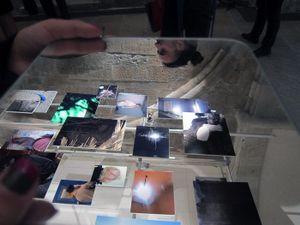
Untitled (I’ve taken too many photos / I’ve never taken a photo) Untitled (I’ve taken too many photos / I’ve never taken a photo) is a spatial photo installation that Kruithof created for her solo exhibition at Tour les Templiers during the Hyeres festival de mode et photography in Hyeres, France. For the exhibition, she installed 75 inkjet prints mounted on dibond of three different sizes on the ceiling of the 12th century commander building. Visitors could use handheld mirrors allowing them to ‘to frame’ and focus on individual images. These pictures derive from a selection out of 300 photographs that are part of Kruithof’s so-called “automagic archive.” This archive contains visual notes – photos she takes every day, but considers to be more than snapshots. She accumulated these pictures during her 10 year artistic practice and stored them on hard drives. In order to look at them in a fresh, new way, she set out to find someone to help her edit her work – someone who had never taken a photograph in his or her life. At the time, Kruithof was living in Bedford-Stuyvesant in Brooklyn, New York, where she posted sign that read “Did You Never Make A Photo In Your Life?” Out of the 12 people that responded, 19 year old Harrison Medina was the only one who had never taken a photograph. After Kruithof’s pre-selection of 300 photographs, Medina chose the remaining 75 images and edited them into three different sizes. Kruithof recorded the conversations during the selection process and printed the edited interview on a free take away poster as part of the exhibition. Her unorthodox installation humorously comments on the proliferation of digital photography and its glut of images in the world. In doing so, Kruithof does not only interrogate the many ways in which we use and perceive photography as medium, but also provides a new experience of looking at photographs. -------------- photo installation 75 inkjetprints on foam in 3 different sizes: 24-32 / 30-40 and 50-70 cm A2 double sited poster / full colour 1000 copies in French & 1000 copies in English to take away for free 30 mirrors solo exhibition at Tour les Templiers during Hyeres festival de mode et photographie in Hyeres France
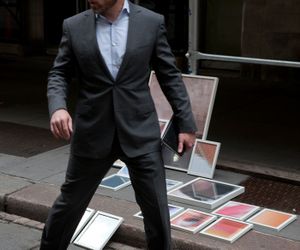
Pixel Stress comprises a publication as well as an installation from a public intervention that Kruithof staged in New York City’s financial district. On the 18th of April, 2013 she and two assistants went to Wall Street and built a temporary installation of 14 framed prints of different sizes on the edge of the city’s pavement. The prints looked like pixilated monochromes, but were in fact illustrations blown up to a maximum size (3200% in Photoshop) of stock images of men and women in suits that Kruithof found through a Google search of the word: stress. Throughout the performance, Kruithof encouraged pedestrians to look at and talk about the works, and subsequently asked if the ones involved would like to buy a print. Since Kruithof was not allowed to conduct monetary transactions, she gave the prints away for free, once a participant had named a price – and thereby established an “imaginary sale.” Value is therefore not created through the well-established system of commercial exchange, but through human interaction, artistic creation and generosity – an idea that Kruithof further develops in her unusual publication. Smooth high gloss paper reproduces the tiny thumbnails of the original internet images as well as their pixilated close ups. Folded into a loose binder that is held together by an elastic band, the book also contains a stapled paper insert illustrating Kruithof’s Wall Street intervention through a sales report, texts, hand cut photomontages and documentary photographs of her interaction with the business men. With gentle humor, her images dissect not only the people, but also their socially established reputation for being powerful and self-assured. By the means of photography, Kruithof suggests that expertise (whether in the fields of art, business or trade) is not a fixed, immutable quality, but a construct that subject to change and questioning, the moment one is confronted with something unexpected. For her solo exhibition with BoetzelaerINispen at UNSEEN Amsterdam, Kruithof showed the project as an installation of 3 photographs, 4 hand cut-photomontages, 5 screenshots and 1 wallpaper of various sizes, all of which were presented on an 8-meter long wall.
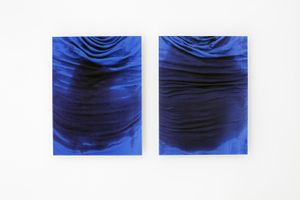
“Sweaty sculptures” and “Sweat-stress” Stress – with its positive and negative effects on the human mind, as well as its physical and chemical residues inside and outside of the human body – is a phenomenon that Kruithof has been interested in for a while. The most immediate physical stress residue is sweat. Kruithof is particularly interested in sweaty armpits, which she perceives as wet circles that equalize aesthetic scars of nervousness and universal discomfort. However, sweaty armpits are often understood as a persistent ‘enemy,’ overshadowing one’s ambitions and provoking the feeling of embarrassment. Within a group of works – Sweaty Sculpture (spectrum and slide) and her series of color photographs entitled Sweat-stress, all of which were part of her solo exhibition “Ever thing is wave” – she explores and celebrates human sweat (and stress), as well as its often disregarded aesthetic and emotional manifestations. The Sweaty Sculptures and the Sweat-stress series present the colorful outcome of a collective performance. Kruithof organized a sweat-workshop to which she invited 25 people to do an extensive work-out in the empty gallery space. Throughout the workshop, Kruithof asked the participants to stop for a moment, so that she could photograph the developing sweat on their clothes. These images of fragmented, emphasized body parts, whether they are presented individually or in form of a sculpture of morphing images, do not only present a new, humorous take on the indexical character that photography has been assigned ever since; they also question the status of the fixed photographic image.
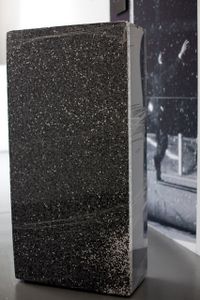
Driving Hazy is a photographic installation consisting of a photographic print directly applied to the wall, a framed photograph and a polystyrene block wrapped with a photo sticker and cellophane foil. For this work, Kruithof went to New York’s financial district and asked people wearing headphones to dance for her. She documented this publically exhibited moment of intimacy by photographing the shadows that appeared on the granite surfaces of the surrounding buildings. With irony and humor Kruithof manages to shift perspectives actually and metaphorically, and reveals the delicate, often disregarded nuances of what it means to watch, observe and being looked at. ----------------- Installation out of sticker photo 180 x 120 cm directly applied on wall Polystyreen base 24 x 100 x 50 cm with photo sticker 100-70 cm sealed with cellophane 30-40 cm framed photo (aluminium frame and blue glass) and one 1 photo: 20-30 cm Ultrachrome print with diasec

Push-up For Push-up, an installation of 14 photographs and one slideshow-projection, Kruithof asked business people to perform as many push-ups as they could at the entrance of large corporation buildings in New York. She continued to photograph them, until security guards told her to leave for liability reasons. Push-up is not the only work in which Kruithof explores New York City’s business world and its people. However, it is the first piece to address the complex, multi-layered notions of power in an explicit, yet symbolic, and particularly playful way. Who are the one actually in charge - the artist directing her participants, the participants themselves while performing their acts of strength in front of the companies they work for, the security guards who ultimately determine the end of the performance, the corporations? This circular power-movement of seeing and being seen is reflected in the installation’s presentation. Kruithof perceives her circle-, or even clock-like arrangement of 14 images of men in different suits and different stages of push-up movements, as a repetitive chain within or model to illustrate the modern business world and mindset. The slideshow-projection that is projected into an empty picture frame emphasizes the humorous, ironic light that Kruithof sheds on the psychosocial state of New York’s contemporary (business world) society.
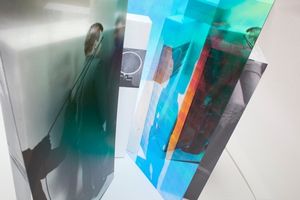
A Façade is not only the visible front of material things; it can also be an invisible wall somebody puts up to protect, pretend or hide behind. Kruithof’s Façade, a photographic sculpture, explores the fragmented and refracted psycho-social state of contemporary New York. Simultaneously enamored with and skeptical of the medium of photography, she re-situates the picture plane onto construction materials – combining photo-stickers, bricks and polystyrene blocks, as well as inkjet prints that sit on radiant and clear Plexiglas. There are images of a shadow of an undefined figure on a brick wall, a back of a man, hands holding a device, part of a recording studio. The large photographs of racks of suits or men of Wall Street reify as packaged building blocks due the way Kruithof wraps the large photo stickers around the polystyrene blocks with cellophane foil. The multi-layered sculpture with shifting views of color and content challenges the viewer’s search for a definitive perspective. Even if the iridescent reflections enliven the otherwise bleak black and white world of corporate America, it’s hard to fathom the anonymity of the image language within this sculpture. Kruithof invites to reflect on the paradigm of every-day business life, but also searches for the moment in which façades begin to crack. --------------------- sculptural situation total size: 110 x 141 x 100 cm 1 inkjetprint on plexiglas radiant 90-140 cm 1 inkjetprint on plexiglas clear 62-120 cm 1 polystyrene block of 25-50-100 cm 1 polystyrene block of 15-50-100 cm 1 polystyrene block of 10-50-100 cm 3 photostickers (24-30 cm and 2 x 100-132 cm) cellophane foil, 5 bricks