Bosfights/ Live Free
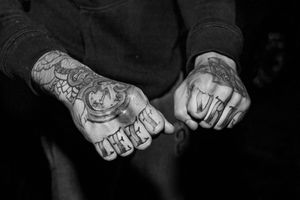
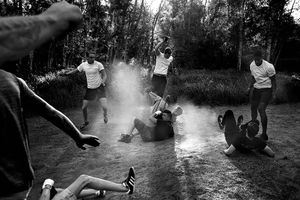
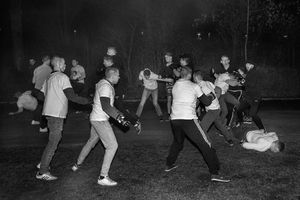
BOSFIGHTS / LIVE FREE Hooliganism has disappeared from the European football stadiums, but the fight has never stopped. Fighters who volunteered to fight for the colors of their club recently found a new home: remote forests. Teams compete with each other in a very organized way, with rules - and strict secrecy. It is known that such forest fights take place in countries such as Russia and Poland. But they also regularly take place in Belgium. Why do these men do this for pleasure? Three years ago I decided to make an attempt to gain access to this hermetically sealed world. The doors opened increasingly hesitantly for me. But the search swallowed me up more than I could ever have imagined. In April 2018 I was arrested and I ended up in jail for three weeks. Police and justice do not believe that I am investigating this subculture, but believe that I am involved. All my images were confiscated. Until today I received nothing in return - the police and the public prosecutor point each other's fingers. Still I worked on. By searching for the material that I had already sent, I was able to recover a small part of years of labor. Of the thousands of images I have saved forty, sometimes of poor quality. In addition, I have bundled newspaper articles, my interrogations, police statements, testimonies, screen shots, the diary of my captivity and screenshots of smartphone films, on which I can be seen as a photographer among the fighting parties. My goal was once to document forest fights. Against my will, I have become part of my work myself. Bosfights by Wilco Vesteeg Violence is a force of human nature. Often repressed, the menacing undertow of violence defines our thought, fears, and hopes, but what happens when we willingly release and find a form for these forces? Sebastian Steveniers is a visual anthropologist trying to understand our full humanity in behavior that is relegated to the margins of society. Bosfights, his series documenting secret meetings of competing football hooligans disturbs our political, aesthetic, and judicial sensibilities, and invites us to rethink what freedom means. Graced with unprecedented access to these fight clubs, Steveniers crawls under the skin of the participants in up-and-close black-and-white photographs: their preparation, comradery, concentration, aggression, weakness: proximity to ultraviolence brings out the full humanity in a context that is often seen as disturbingly inhuman. In the world of Bosfights, animosity is turned into respect, enemies into friends, and violence becomes the ultimate expression of the will to live freely. Freedom is literally inscribed on the bodies of these fighters: broken bones, scars and tattoos are the signs of liberations and regeneration through violence. The participants find meaning and self-realization in these intense moments in which reality becomes real and in which the paradox of freedom is incarnate: we have no choice but to be free, and to explore our freedom beyond the limits of what is deemed acceptable even if it means endangering oneself. Bosfights itself bares the traces of another form of violence. Steveniers has paid for his work with violent arrest, intense interrogation, three weeks in jail, and being charged with membership of a violent militia. Most of his work is lost in a legal limbo: salvaged images, screenshots, legal testimonies, and diary entries now make up a work that originally consisted of thousands of now-lost photographs. Bosfights threatens the status-quo and unveils our hypocrisy vis-à-vis society: The ubiquity of violence on screens, on our militarized borders and in the increasing tendency to criminalize or pathologize difference have become normal, while we are estranged from our most intimate violent urges. In showing this, Bosfights is an ode to freedom.
No categories selected
Photos (10)