
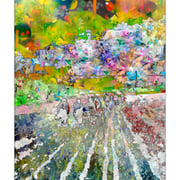
The magic wand tool
One of the oldest Photoshop selection tools, the Magic Wand uses algorithms to select pixels based on tone and color. However, the iconic tool has been criticized by users because it is extremely difficult to harness, and many people think it is highly unpredictable. From the middle of March 2022, my family and I personally experienced two and a half months of citywide lockdown in Shanghai. Until the end of November, the Chinese government is still sticking to the “Dynamic Zero-COVID” policy, which translates into a colossal project that requires huge social resources, human resources, management capabilities, and economic costs. Because different regional governments are arbitrary in implementing the policy, unnecessary and over-zealous restrictions can be seen everywhere across China, leading to a landscape in which residents in different parts of the country have to face completely different anti-COVID rules and survival challenges. In a sense, the “Dynamic Zero-COVID” policy is just like Photoshop’s Magic Wand tool, being quite random in selecting graphic elements. Although China's Internet is highly censored, countless social chaos, protests, and tragedies, all resulting from the extreme anti-COVID policies, are still captured by people’s mobile phones and uploaded to social media platforms every day. Although such contents will be quickly removed, it is obvious that the frequency of these negative incidents and the pace of their amplification have far exceeded the technical capacity of Internet censorship. In other words, the entire Chinese society is now wreathed in various forms of anger. After collecting such pictures, I use Photoshop to enlarge the images and apply the Magic Wand tool to outline various characters and environments. They are then covered with large quantities of artworks I previously captured at art fairs that are marred by the Patch Tool, (Patch tool is a cloning and replace tool in Photoshop). Based on marred images, such visual outcomes blur the information transmitted by the original images. Careful observation is required to avoid the visual interferences caused by the deconstructed and compromised artworks that overlay the original images. The works seek to echo a practice commonly adopted by the Chinese press to maintain social stability, which is shifting the focus of public attention with entertainment-driven coverage. Of course, such a methodology (in which I process my submitted works) can also be seen as a kind of disguise that attempts to secure evidence in an authoritarian world that emphasizes information control.
No categories selected
Photos (17)


