Matsubara-danchi: Fukase’s coffin of shadows
By
Davide Orlando
Background
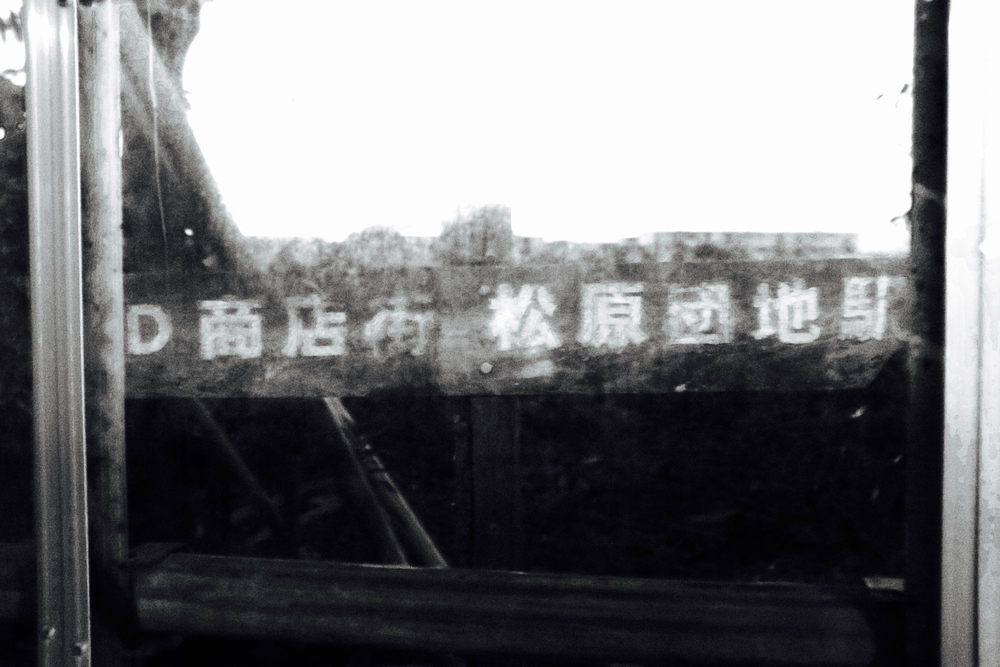
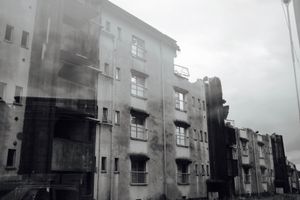
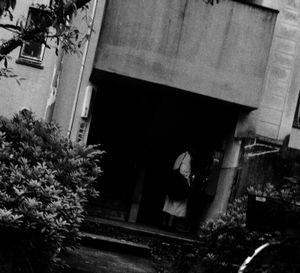
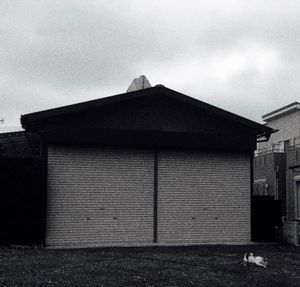
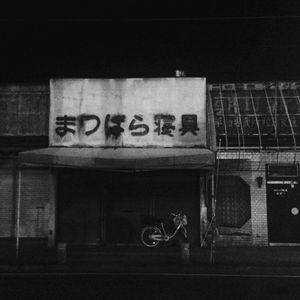
Living in the same locality of Masahisa Fukase, I trace his steps through these 10 photos. They follow a two year catalogue of the changing aspects of the town Matsubara-danchi, the town where he lived. I show the ‘after’ of what Fukase showed ‘before’
The words ‘matsu’, 松 and ‘bara’, 原 directly translated mean, ‘field of pines‘ or ‘original pines‘. However, the spoken word ‘matsu’ can have two distinct meanings with Chinese character; the second meaning, 末, reads as ‘end’. In addition, the word ‘bara’ in Italian means ‘coffin’. By mixing the Japanese word ‘matsu’ with the Italian word ‘bara’ and translating both into English it takes on new meaning: ‘the final coffin’, ‘the coffin to the end’. My representation is the journey towards the coffin, the end. The meaning is pertinent as it captures the gradual and inevitable decline of this former town of Fukase before it is totally erased.
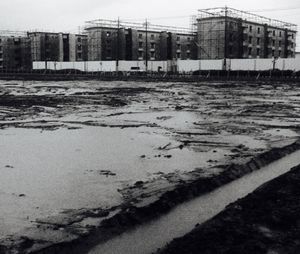
Matsubara, was a subsidised government housing project which grew out of waste marsh land. Developed 1962, it was projected to be a suburban garden city for Tokyo commuters. Branded as ‘the greatest mammoth housing spot of the East’, its vast generic architecture of mainly three and four story blocks nurtured three generations. In the last years, the characteristics of this development have seen decay both in the context of the ideologies of the town, and the dissipation of a community as stages for redevelopment have forced old time residents to abandon their homes and relocate.
The aspirations that Matsubara-danchi’s urban planners projected, contrast with Fukase’s published work and his biographies which allude to his falling victim to the oppressive spirits, his personal fight with demons, and his obsessive nature. In his documentation of Matsubara, there is much emphasis on the alienation and loneliness of his life (Hysteric Twelve, 2004), and at other times we see a dislocation from his environment: his series of photos of his second wife, Yohko, taken from his apartment window (Fukase, 1978). Yet, images also capture moments of fun, purity and love where his subjects are his tamed cats rescued from the gardens surrounding the danchi (Wonderful Days, 2015; Afterword 2017).
The Photos
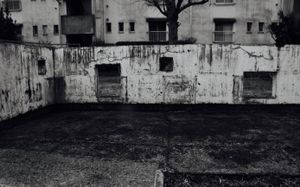
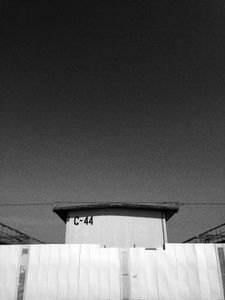
The photos document what is left of Fukase’s home, Matsubara-danchi. Where in his lifetime it was a domesticated community and a playground for feral cats, now it has become an environment almost drained of spirit, identity and life as it is in its transitional stage before demolition.
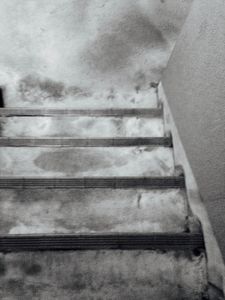
In the photos, I try to capture the stench of decay, all the more poignant as the damp geographical location, the rainy season, and humidity feed into the slow process of rotting. The ghosts in the shadows of this area leave impressions of life-patterns and time. Their whispers elicit an implicit knowledge that act as a reminder of past in the present.
Though with hindsight the ideologies and promises that the estate proclaimed may be construed as delusional, there are traces of beauty which reach out from the shadows. The socioeconomic context and micro-identities are conceptual and are left to the viewer to construct. Though I do not codify each photograph, I have tried to represent themes through conjunction and disjunction.
Plans for demolition presents us with the dichotomy of provenance and fate. Soon, Fukase`s Danchi of Matsubara will be erased, but, as with a wake, the coffin, the ‘bara’, will seal the remains and reminiscences of a time gone by.
Saitama, 16 May 2017
Notes and References:
Matsubara-danchi Sta. to Be Renamed in Spring. 2017. Soka City Website. Retrieved from:http://www.city.soka.saitama.jp/english/news/2016/160720/0101.html
Fukase, M. 1978. Yohko. Asahi Sonogram 8, Japan.
Fukase, M. 2004. Hysteric Twelve. Hysteric Glamour, Japan.
Fukase, M. 2015. Wonderful Days. Roshin Books, Japan.
Fukase, M. 2016. Afterword. Roshin Books, Japan.