
La vocale "A"
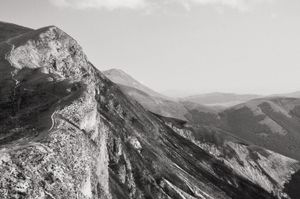
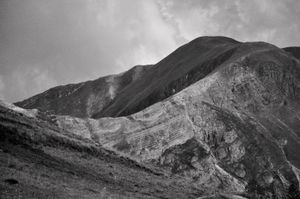
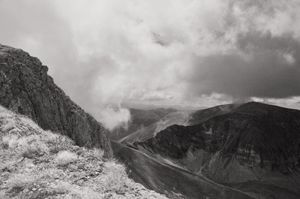
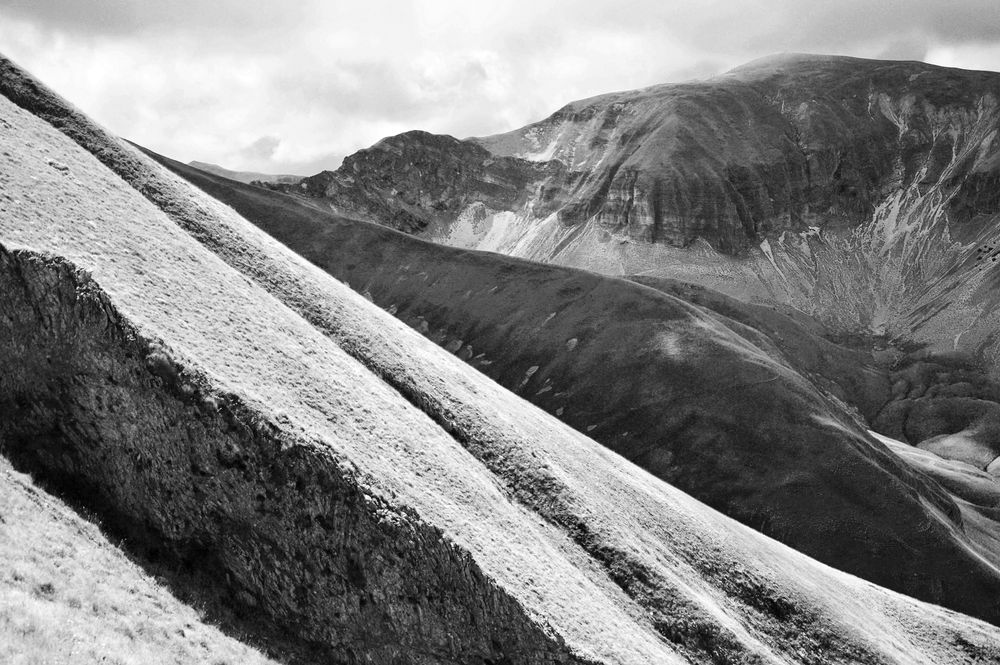
La vocale "A" (the voice "A") Note: - in Italian, nouns ending in -a are nearly always feminine, e.g. montagna (mountain). - the word alpinista (mountaineer) can instead be either feminine or masculine. Its gender can be found out by looking at the indefinite article: un alpinista is masculine while una alpinista is feminine. Since the final "a" of the article una is always replaced by an apostrophe when the following noun starts with a vowel, the standard feminine form is un'alpinista. I imagine mountain's nature to be purely feminine. The mountain skyline forms a continuous, almost uninterrupted line, which is sometimes ‒ just apparently ‒ broken. Mountains are made of passages, curves, uphills and downhills, never-ending views and peaceful valleys. "I climb for myself, I climb because of my hunger for mountain. I am a mountaineer [un'alpinista], but one with the apostrophe. That apostrophe is my woman's flag, which I planted and flies up there. When I reach the mountaintop and some freezing oxygen enters the body, sets in thick blood and makes the heart swell up, I know I am feeling something that no man could ever feel. I am not a mother, I have not given birth, my fertility fades a little more every day. But up there, I am the mountain, I am Nieves the stone, Nieves the snow, I am mother nature who visits the highest step beneath the sky. Up there I am matter, I am mother earth [madre terra in Italian], mother-of-pearl [madreperla], madrepore ‒ which is a type of coral, I am the honeysuckle [madreselva], I am all the mother-something words that I could find in the vocabulary. I am the vowel "a", the feminine suffix that gives life to the world. Up there I put an "a" at the end of every word, of every passage. Up there I know that the gender of the world is feminine, that it is strength, light, air. That is why I am the apostrophe before the noun alpinista. For men, reaching the top is fulfilling a desire, to me the top of a mountain is where I connect with all of the feminine that exists in nature. Up there I do not exult. Being up there is getting to the last stitch of a seam, when you bite the thread just after the knot and you brake it. Up there I complete a mend." (from "Sulla traccia di Nives", by Erri De Luca) Please note: the English translation of this passage from the book "Sulla traccia di Nives" by Erri De Luca was made on the occasion on this photography project. It has not been published nor was it approved by the author.
No categories selected
Photos (8)