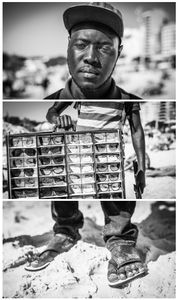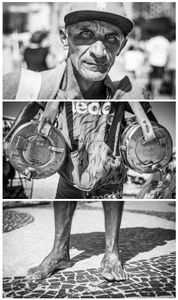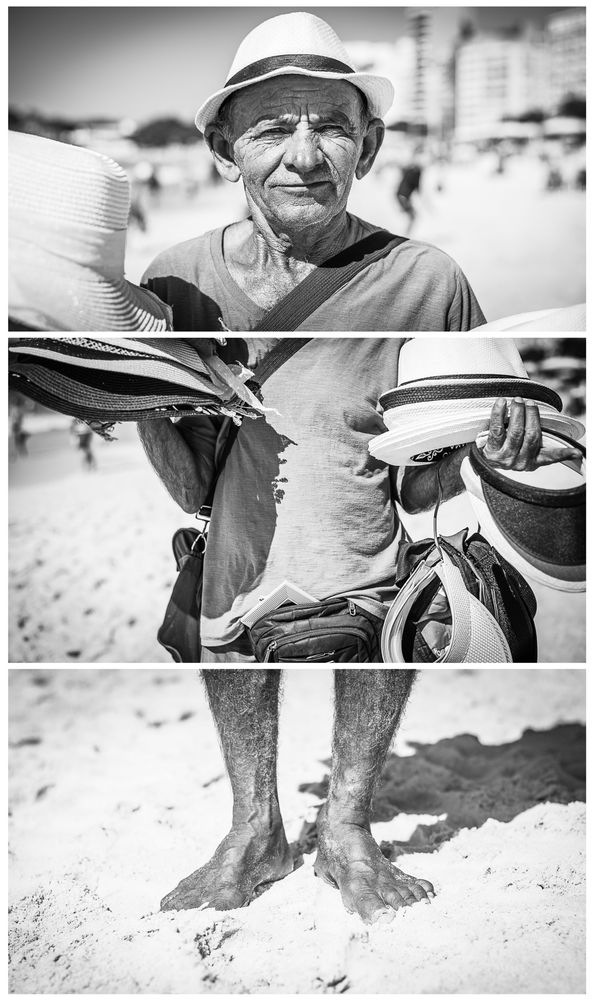

Workers of Sand
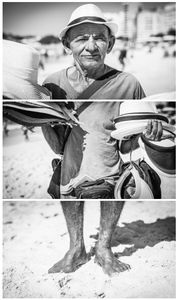
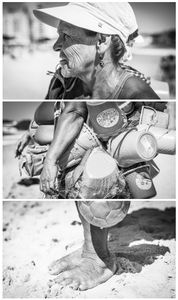
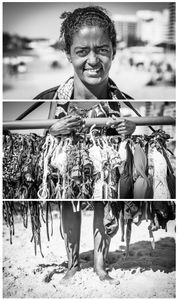
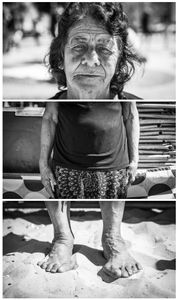
The essay “Workers of Sand” brings together triptychs formed by expressive cuts of the reality of the workers who make a living walking almost 15 miles a day on the world famous (and scalding) sands of Copacabana beach. The figure of the “sand worker” represents not only a job, but also a heritage of the Brazilian beach culture, especially in the city of Rio de Janeiro. All kind of things are sold by them: food, drinks, sunscreen, hats, bikinis, souvenirs and what else imagination can think of. Heavy loads of goods and dreams on their back, while you and me are enjoying our lazy holidays laying under a blue sky and to the sound of a good samba. The paneling, fracturing, and distortion present in these images represents fragments of the time, bodies, and goods of these characters, as “miniatures of reality that anyone can make or acquire”, citing Susan Sontag's excerpt, “In Plato's Cave”. Its aesthetic approach acts, as well, to represent the impact of larger national issues of Brazil on its people and the deconstruction cause by constant social, economic and political crises. Part of the inspiration comes from songs of the Brazilian singer and composer Gonzaguinha (1945-1991), as "Comportamento Geral" (General behavior) and "Dias de Santos e Silvas" (Days of Santos e Silvas). Throughout the 70's and 80's his lyrics expressed, with an ironic and cleaver poetry, the struggle, resignation and good mood of Brazilian people despite hard times on daily life. Unfortunately, the message of those songs remains as actual as ever before. Uncountable new corruption scandals (probably the biggest ever) brought up a more complex social, economic and political crises to Brazil. The State of Rio, for instance, was left broken in a way not seen for years and security is again a major concern. As population face many adversities, these honest hard workers are also having their daily activities jeopardized by the State negligence. Men and women, strong people with their bare and hurt feet on the scalding sand and a heavy duty on their shoulders, that struggle to earn enough for a dignified life and sometimes are even mistaken for bandits, as real thugs started to pretend being sellers in order to steal from people on the sands. Despite this unfavorable condition, they are still showing good humor and resignation, as in Gonzaguinha's songs, and keep their ability to transform a reality broken by the omission of the State in convenience to thousands of tourists and locals, who enjoy a sunny day on the beaches of Rio de Janeiro. This is an ongoing project, which wants to bring these workers to light and highlight this peculiar characteristic of people in Brazil: always carry strength, good humor and a strong will to go on, no matter what.
No categories selected
Photos (6)