Tea Horse Road

Photos (35)
Cover
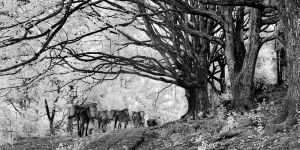
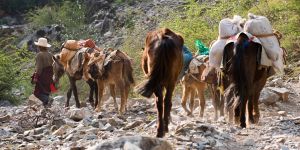
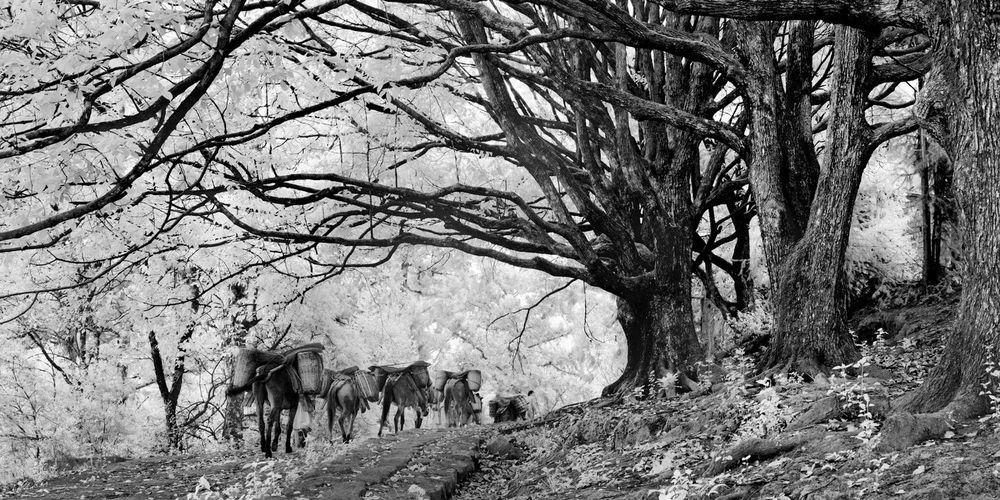
Horses and mules still ply a southern section of the road leading towards Burma from Heshun, an old village close to Tengchong, passing under a stand of old banyan trees © Michael Freeman
File: 19185_02-13-25crop_ChaMaGuDao_original.jpg
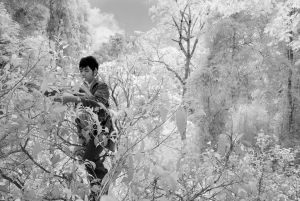
April tea-picking on Bulangshan, where the Akha ethnic group maintain some of the most highly regarded Pu’er tea gardens. © Michael Freeman
File: 19135_32bw_Tea-picking_original.jpg
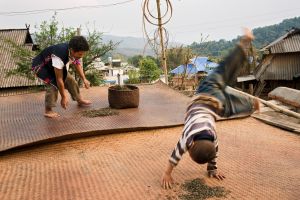
Lau Da, recently retired as the village leader of Baljalpashu, gathers up leaves that have been spread out to dry for the day on mats on the terrace of his house, as his youngest son practices somersaults. © Michael Freeman
File: 19136_17_XinBanzhang_original.jpg
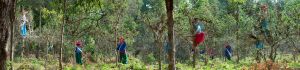
Bulang women from Mang Jing village make a ritual collection of leaves in one of the mountain’s agro-forest tea gardens. © Michael Freeman
File: 19156_55-9_Teapicking_Jingmaishan_original.jpg
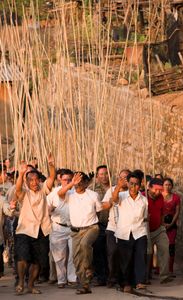
A procession of Dai rocketeers dances its way through Meng Ben’s main street up to a nearby hill where the rockets will be launched. at the start of the picking season on Jingmaishan © Michael Freeman
File: 19146_15_Rocketlaunching_original.jpg
The Dazang, or spiritual leader of the Bulang community at Laomange on Bulangshan. © Michael Freeman
File: 19142_05_Bulangspiritualleader_original.jpg
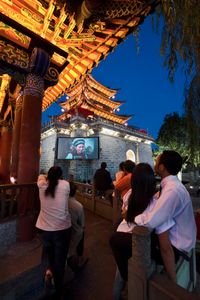
At the centre of Dali old town (Dali Gu Chang), a well-known 1950s movie 'Five Golden Flowers' that was filmed here is shown nightly at the Wu Hua Lou tower.  © Michael Freeman
File: 19222_81_Dali_original.jpg
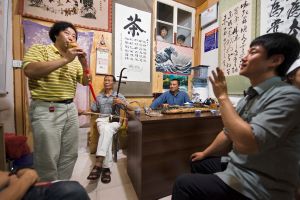
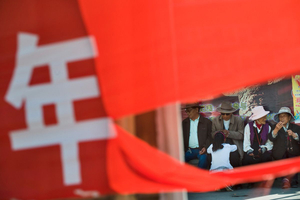
At a Weishan teashop,, a group of friends gather to listen to a duet on two traditional Chinese instruments: the flute-like hulusi and the two-stringed arhu. The large character in calligraphy on the wall is ‘tea’. © Michael Freeman
File: 19225_28_Weishan_original.jpg
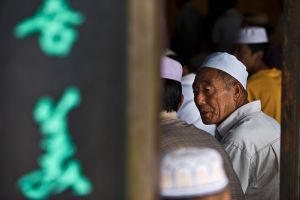
Saturday afternoon prayers at the mosque of Dong Lian Hua ('East of the Lotus Flowers'), a Muslim village just north of Weishan, that ran many of the pack trains (mabang) in this area. © Michael Freeman
File: 19231_44_DongLianHuaMosque_original.jpg
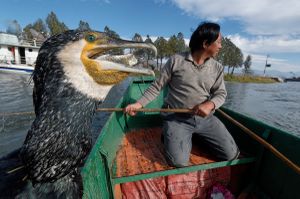
Cormorant fishing remains part of the Bai economy on Erhai, but is in decline. The number of fishing families fell from 72 in 1985 to 27 in 1995, and continues to drop. © Michael Freeman
File: 18938.16_Cormorant_fishing_original.jpg
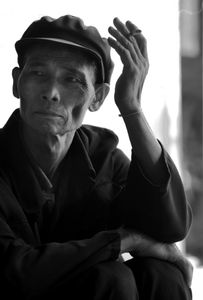
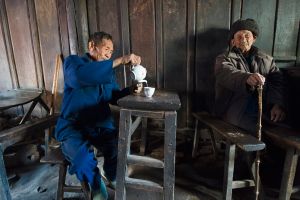
Retired villagers in Banqiao, close to the southwestern Yunnan city of Baoshan, gather every day to pass the the time in a local tea-house that has changed little in its 140 year-old history. © Michael Freeman
File: 19295_47_Banqiao_teashop_original.jpg
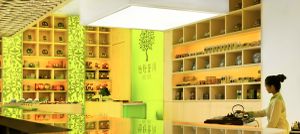
Looking for new heights of elegance and refinement, a tea shop in the heart of Yunnan’s capital, Kunming, has been designed by Hermès, the French luxury products company. © Michael Freeman
File: 19159_21-24_PurePuer_original.jpg
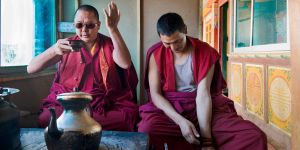
Tibetans took Chinese tea from the south and turned it into a very different, full-bodied nutritional drink, adding yak butter and salt. Monks at Songzanlin monastery in Shangri-La enjoy a morning cup. © Michael Freeman
File: 19160_75_crop_Songzanlin_monastery_original.jpg
A pack train descends the stone stretch of the old road, carrying goods from Deqin to the village of Adong. Tea now travels everywhere by truck. © Michael Freeman
File: 19179_95crop_ChaMaGuDao_original.jpg
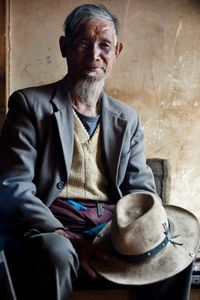
Nobu Qili, an 81-year old veteran of the Tea-Horse Road, from Tangpeicun village, near Zhongdian.  © Michael Freeman
File: 19165_73_ChaMaGuDao_veteran_original.jpg
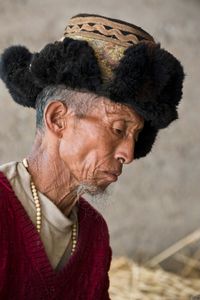
Zhi Shi Dun Zhu, a 75-year old veteran of the road, at Adong © Michael Freeman
File: 19177_50_ChaMaGuDao_veteran_original.jpg
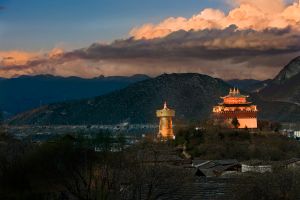
Zhongdian, or Gyalthang in Tibetan, was re-named  Shangri-La in 2001, after James Hilton’s 1933 novel Lost Horizons. This was the last trading post before the caravans negotiated the Hengduan Mountains. © Michael Freeman
File: 19180_304145_Zhongdian_original.jpg
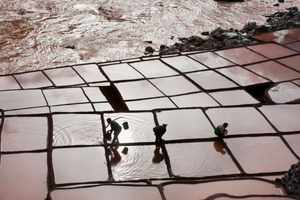
The Tea Horse Road accommodated other goods, and one of the most important was salt. On a bend in the Mekong 70 kilometres upriver from Xidang are the unique Yanjing salt pans. © Michael Freeman
File: 19270_61_SaltPans_original.jpg
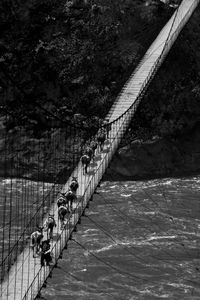
Pack horses cross the Shi Yi Luo bridge across the Yalong River south of 7000-metre Gonggashan. © Michael Freeman
File: 19233_48bw_YalongRiverGorge_original.jpg
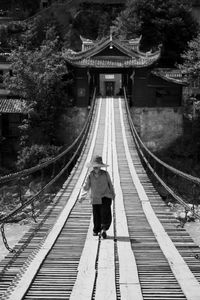
The Luding Bridge, built in 1705, became the official control point for the Qing government, where the yin quota tickets on the tea bales were checked. © Michael Freeman
File: 19256_81_LudingBridge_original.jpg
Two days north then west by packtrain from the Luding Bridge, Kangding was the major hub for western Sichuan, and remains the largest Khampa town. © Michael Freeman
File: 19236_42_Kangding_original.jpg
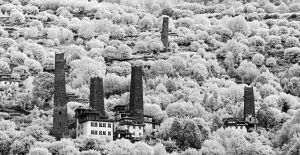
Unique to this area, defensive stone watchtowers are scattered over the mountain slopes overlooking the upper Dadu River near the town of Danba. 562 of these structures, which range in height from 10 to 60 metres, were counted in 2004, but they previously numbered in the thousands. © Michael Freeman
File: 19238_3539bwv1_Watchtowers_original.jpg
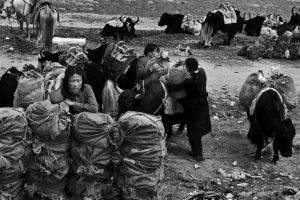
Just outside the settlement of Manigange, a team of Khampa men load up a caravan of yak with traditional leather sacks, bound for Dege © Michael Freeman
File: 19248_54_Yak_caravan_original.jpg
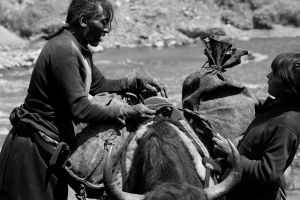
Just outside the settlement of Manigange, a team of Khampa men load up a caravan of yak with traditional leather sacks, bound for Dege © Michael Freeman
File: 19248_82v2_Yak_caravan_original.jpg
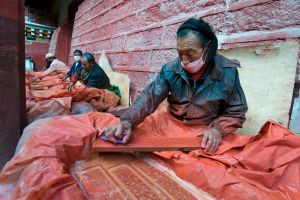
The Sutra Printing House at Dege is the most important repository of wood-block Buddhist scriptures in the Buddhist world. © Michael Freeman
File: 19250_21_Dege_original.jpg
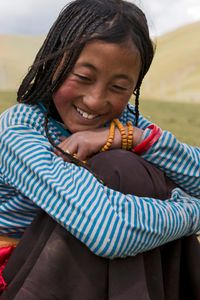
A Khampa nomad girl on the Liyang Grassland. © Michael Freeman
File: 19254_45_Khampa_nomad_girl_original.jpg
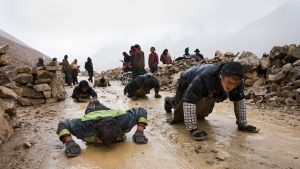
A group of young Tibetan men from Litang crosses the 5,000 metre Dongda Pass on the former tea Horse Road to Lhasa, body-length at a time on their several-month pilgrimage. © Michael Freeman
File: 19269_79_Chak_original.jpg
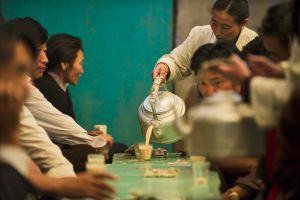
The Gum Chu Tea House, one of the oldest and best known in Lhasa, around the corner from the Jokhang. © Michael Freeman
File: 19261_86_GumChuTeahouse_original.jpg
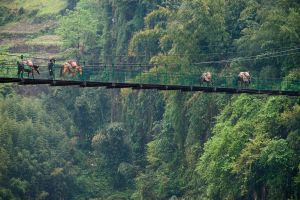
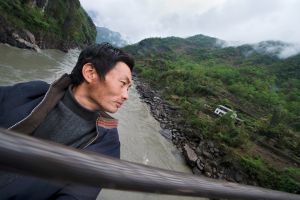
Horses crossing the Nujiang gorge near Fugong over a narrow suspension bridge. © Michael Freeman
File: 19342_52_Nujiangbridge_original.jpg
At one time the only way for most people of crossing fast and dangerous rivers, cable slides are still in use by the Lisu minority across the gorge of the Nujiang, the ‘Angry River’. © Michael Freeman
File: 19343_68_CableSlide_original.jpg
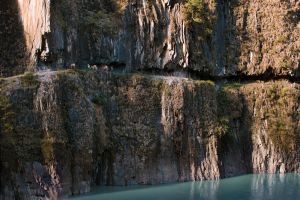
On the upper Nujiang River,, close to the Tibetan border, the vertical limestone cliffs made it necessary for muleteers to cut the path directly into the rock. © Michael Freeman
File: 19339_58-7495053_CliffTrail_original.jpg
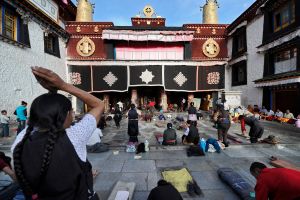
Pilgrims and local residents pray in the courtyard in front of the main entrance to the Jokhang, the temple and monastery at the heart of Lhasa, and the focus of the chak pilgrims. © Michael Freeman
File: 19258_12_Jokhang_original.jpg
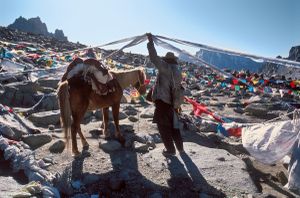
At the highest point on the kora around sacred Mt. Kailash,, the 5,630-metre Drolma La, a Tibetan pilgrim leads his horse under lines of banners. © Michael Freeman
File: 15299_21_DrolmaLa_original.jpg
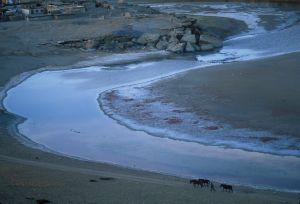
Relieved of their packs for the night, horses are led by their owner along the banks of a stream flowing into Lake Manasarovar, close to Mount Kailash. © Michael Freeman
File: 15310_35_LakeManasarovar_original.jpg
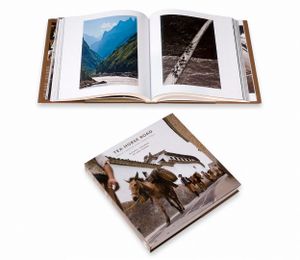
File: THR_cover_open_crop.jpg