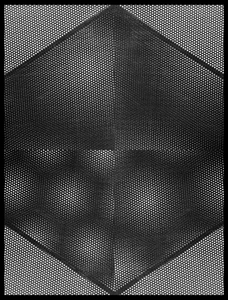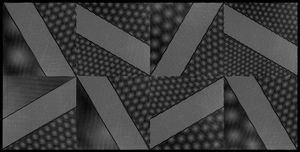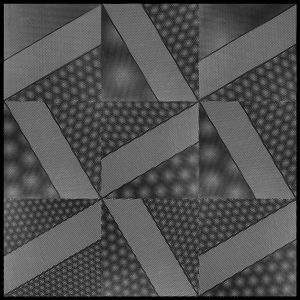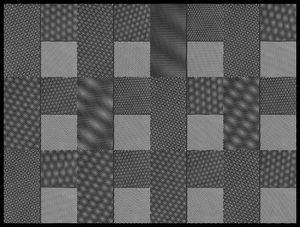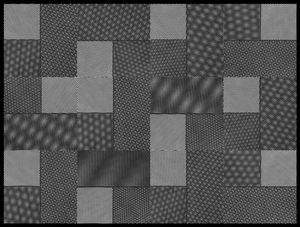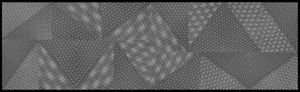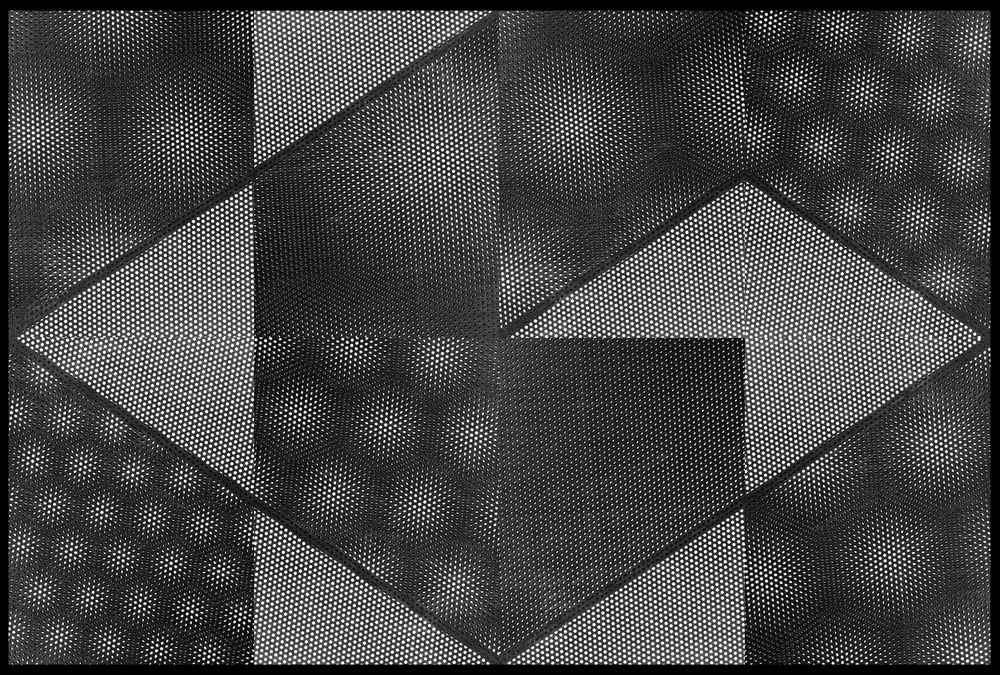
The series "Interference" consists of composite images made from photographs of over-layed sheets of perforated metal or hexagonal aluminium mesh. Variations in the orientation of the layers create a range of moiré (interference) patterns, which are optically unstable and vary according to viewing distance. Seen from very close up the images reveal their origins as highly detailed ‘straight’ photographs of the surface of the metal sheets; from further away the moiré effects dominate perception of the work. To enhance this phenomenon the images are printed to a large scale with some works in the series being three meters wide. Other than compositing individual shots into larger compositions no digital manipulation is used in producing the work. Images are printed on brushed dibond using a direct to media inkjet process.
Interference forms part of an ongoing investigation into the ontology of the photograph and in particular the relationship of a photographic image to the concept of ‘intending’ as understood in phenomenology. The oscillation between the ‘straight’ photographic record of the surface of pieces of metal and the optical effect of the patterns, leaves a gap in which the viewer effectively chooses how to read the image. It is important that the works look both like and unlike photographs, effectively blurring distinctions between photography and drawing as systems of image making. The conflicted readings are further complicated by contingent suggestions of pictorial systems, such as isometric projection and perspective, created by the orientation of the individual component frames. The series aims to make apparent the underlying acts of ‘intending’ that we must bring to all pictorial experience in order to categorise and make sense of it.