
Pop Loneliness
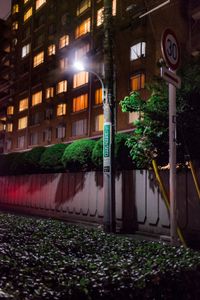
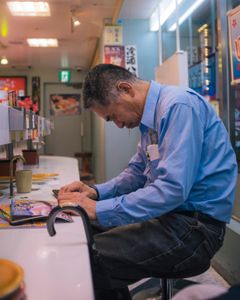
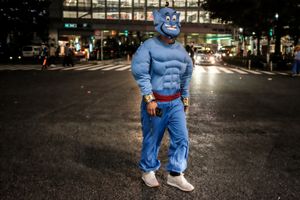
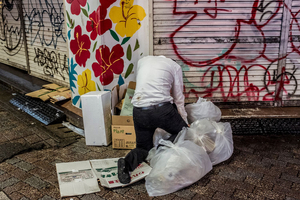
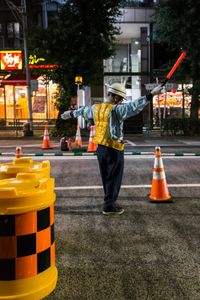
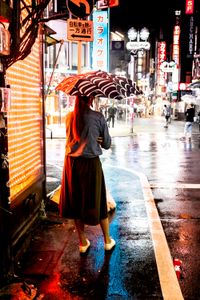
The first thing that shocks you when you penetrate the Tokyo night is the light. An ubiquitous, colorful, powerful, stimulating, intoxicating artificial light that takes your sleep to make your awakening a dream. “Electric city”, Tokyo is also the city of fantasy, where everything seems possible in the irradiated eyes of the night owls populating it. in the eyes of the gaijin – the stranger – I am: the emotional misery that seems to roam every streets, every bars, every clubs, every arcades where the lights are however so shimmering. This paradox, I found it elsewhere, but never as systematically as in Tokyo. In the nights of the Japanese capital, you seek a remedy for your loneliness. In most cases, you only find other insoluble lonelinesses. “Pop”, as its sound indicates, is what sparkles. It is the culture of entertainment, which stimulates as much as it reassures. That’s the joyful songs played in Shibuya karaoke, the colorful costumes that squat invades the advertising boards and the streets of Roppongi, the noisy video games played in Shinjuku arcades. That’s the fluorescent light of all the signs, in the most vivid colors that are. Or the omnipresence of the floral motifs, on the dresses as on the walls. But pop(-ular) is also, in its first sociological sense, what is shared, common to a people. If the loneliness of the Tokyo night is pop, that’s not only because it masks itself with gentle and colored artifices, that’s also and above all because it is shared, and understood as such. That’s a common loneliness, a community of loners, whose members do not go out to find (a) partner(s), but on the contrary to be alone with others – the rows of arcades, without direct contact with your opponent, though he’s less than one meter from you, are the best example. Not a conscious search, this isolation is experienced as fatality, whose weight can be felt on the downcast shoulders of shameful night owls. Because all that is shared is also contagious, this solitude affects even non-human life forms. By making animals a palliative to this emotional lack, they isolate them in a world that is not theirs, secluded from their fellow creatures. The man – and his smartphone – then replace the city in the “glamorizing” and coercive process of put on loneliness of the animal, who becomes a mirror of the human condition. This series is presented as a case study, a set of situations captured on the spot, in a quasi-intrusive way, where misery and camouflage, loneliness and pop intertwine. The similarity of stances, looks and situations creates an oppressive impression of repetition. It is the proof through the absurd of the character specific to a population. And the photographic particularity of a city. To hide its evil, Tokyo doesn’t shade, but on the contrary dazzled.
No categories selected
Photos (16)