
Tim Bowditch's Projects
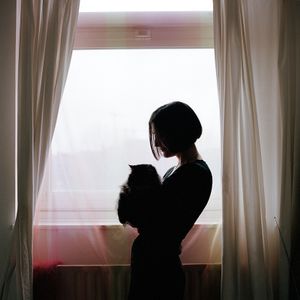
A series of portraits made in 2009 of the artists in the Bow Arts Trust live/work housing scheme in Bow, London.
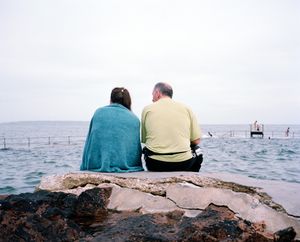
FILM AND VIDEOS https://vimeo.com/28002897 https://vimeo.com/22529311 https://vimeo.com/28208673 https://vimeo.com/23156951 https://vimeo.com/42830807 Firedive is the name of a film by Tim Bowditch about La Vallette bathing pools on the island of Guernsey. Firedive is also the name for the three-year project centred around the bathing pools which began in 2009, and culminated in 2012 with an exhibition of the Firedive film along with three new artworks commissioned in response to the film and La Vallette pools. Tim went to Guernsey to film the pools for Firedive in 2010. He screened the film along with an exhibition of videos at Guernsey Swimming Club's 125th anniversary gala in 2011, and he commissioned three UK artists to create new work for an exhibition about La Vallette bathing pools called Forwards, backwards and forwards again, at the greenhouse in St Peter's Port in 2012. In 2009, Tim visited La Vallette with a medium format camera, trying to capture the architecture of the bathing pools whilst they were in use in the summer months. These pictures were the beginning of the entire Firedive project. From the pictures Tim had taken, he began to formulate an idea for a film which would be a portrait of La Vallette bathing pools as it is now, with a spoken narrative evoking La Vallette as it used to be. Up until the 1970s, night time swimming galas took place at the bathing pools over the summer months. These galas culminated in a torch-lit procession by the members of the swimming club. After the torches were extinguished a circle of petrol was set alight in the pool and a diver would leap from the five metre board, down through the flames and into the water. This was the firedive which inspires the title of Tim's film. Originally Firedive was to be a single take, 16mm film with the camera lifting slowly past the one remaining diving board. As the idea for the film became more complex, the 16mm was replaced with HD digital video for practical purposes. Through discussions and conversations, not least between Tim and his mother – who lives in Guernsey, and whose own mother had worked at the bathing pools in its heyday - Tim decided to stage his own torch-lit procession at the pools. The film of this night time procession makes up the visual element of Firedive, along with footage of La Vallette in the day time and as the sun sets. Whilst in Guernsey, Tim conducted interviews with local people who had taken part in the original night time galas. These included swimmers who had done the firedive when the boards were still in place, as well as members of the 'crazy gang' – who entertained the gala audience with their antics in between the swimming events. These interviews were edited to tell the story of La Vallette bathing pools. The narration is overlaid on to field recordings and soundscapes made at the bathing pools and around the island, and becomes the soundtrack to Firedive. Whilst working on the film in Guernsey, Tim shot many hours of footage which couldn't be used in the final edit of Firedive. Instead, this footage was made into four supplementary videos: Tom Walsh 1963 Guernsey Swimming Club Handbook, a film of the empty bathing pools at night, with Tom Walsh reading out a list of gala events from the 1963 GSC Handbook; Morning Swimmers, documenting a group of outdoor swimmers who arrive at the bathing pools for a sunrise swim, every day of the year; Heyward Quevatre, an hour long interview with Heyward, a native Guernseyman diver who trained down at the pools and swam almost every day of his life; and Heyward Quevatre Photo Archive, a film of Heyward showing Tim his photo archive of La Vallette pools and explaining the story behind each image. In August 2011, Tim Bowditch returned to Guernsey with the completed film and it was screened as part of the 125th anniversary celebrations of the Guernsey Swimming Club. A screen was erected at the pools, and after the GSC's swimming gala (the first since 1986), Firedive was shown to an audience of swimming club members, La Vallette regulars and intrigued visitors. After the film, the swimming club staged their own torch-lit procession with 125 torches – one for each year of the club’s existence. As well as the poolside screening of Firedive, the supplementary video works were exhibited on televisions in the changing room of the bathing pools. Along with Tim, three artists came to the island for the gala: Sybella Perry, Theo Niderost and David Angus. Each had a brief to make new art work in response to the film screening, the gala, and the bathing pools. The artists spent a week on the island, looking, thinking and making, before heading back to the mainland to finish their work. In April 2012, Forwards, backwards and forwards again opened at the greenhouse in St Peter Port, Guernsey. Firedive was exhibited, alongside the work of the three artists who came to Guernsey in 2011. Sybella Perry, Theo Niderost and David Angus were invited to Guernsey to witness the screening of Firedive at the pools. This experience, along with the rest of their time spent in Guernsey, informed the work that made up Forwards, backwards and forwards again. Out Of Vision by Sybella Perry is a film about the screening of Firedive and a re-enactment of the themes that permeate Tim’s film. Sybella documented the whole of the swimming gala; from the setting up of the projection screen, right through to the torch-lit procession that finished the event. An interview with Tim plays out over the edited footage, explaining the reasoning behind Firedive. “Out-of-vision” is a term taken from television broadcasting, when a news reader or continuity announcer speaks over pre-recorded footage, rather than directly to camera. Here, Tim becomes the announcer and Firedive itself is “out-of-vision”. We never see the screening, only the activity surrounding it. Out Of Vision inhabits the same filmic space as Firedive – certain scenes from Firedive are almost re-shot, with slight differences in camera angle and lighting. But, just as Firedive never depicts the real firedives that took place at the swimming galas, Out Of Vision only shows the action that happens around the screening of Firedive, and never the film itself. Theo Niderost’s La Vallette: Three Exposures is another document of the screening, but unlike Out Of Vision, it is at one remove from the content of the film. Where Firedive and Out Of Vision are made up of close shots documenting the human activity at La Vallette, Theo’s photographs capture the architecture of the pools as a whole. There is a literal distancing of Theo’s camera from the pools which is quite different from the intimacy of Firedive and Out Of Vision. There is also a more symbolic distancing. The three photographs are all long exposures, which places them outside of a cinematic time. The photographs are a spatial representation of the pools, rather than a temporal representation. And yet, the long exposure process is just another way of making a portrait of the pools. In Theo’s Procession, the shape of the pools is clearly defined by the flaming torches being carried around the edge of the water – blurring time, but clearly defining space. Interestingly, for this image, Theo constructed his own pinhole camera. The pools were designed in response to the tides, and his camera was, in turn, designed in response to the pools. Theo’s widening of the literal and metaphorical frame of his images allows us to think differently about La Vallette. The pools are an example of human engineering, which not only have social use embedded within their design, but also an understanding of processes outside human control, like the motion of the rising and falling of the tides. If we think of Sybella’s Out Of Vision as inhabiting the same space as Firedive, and Theo’s photographs as being at one remove, then David Angus’s Mechanical Tides is another step back from the human activity that goes on at the pools. With Mechanical Tides David invites us to consider the underlying tidal process that shapes the pools’ design. Whilst in Guernsey, David documented the movement of the moon across the night sky from the vantage point of the pools. In the gallery space, with a 35mm slide-projector rigged up to a pulley system, he created a kinetic sculpture that pulls a piece of blue acetate up and down the wall as the moon moves across the frame of his slides, mimicking the gravitational pull that creates the lunar tides. David worked on the production of Firedive with Tim back in 2010. At the time, he was struck by how the tides defined their ability to film, so that on a given day they might only have a few hours down at the pools, between low and high tide. The photographs for Mechanical Tides were taken at La Vallette, acting out the specific effect that the tide had on the production of Firedive. But for the viewer of Mechanical Tides, the photographs could have been taken anywhere. In normal life, we do not work out the tides through a rational understanding of the gravitational pull of the moon, but through human constructs like tide tables. The pools are a visible tide table, their design displays a concrete understanding of the movements of the sea. David’s work pulls back from the human use of La Vallette, and places the environment within a wider scientific context. Each of the artists’ works relates to the pools, but in progressively more abstract ways: the social history of Firedive, the vibrant human activity in Out Of Vision, the spatial portraiture of Three Exposures, and the abstract representation of Mechanical Tides. Forwards, backwards and forwards again was the culmination of the three-year Firedive project; a temporary memorial to La Vallette bathing pools and its changing role in the coastal culture of Guernsey.
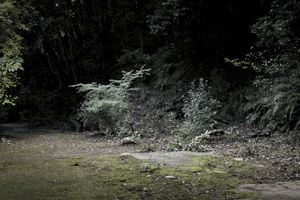
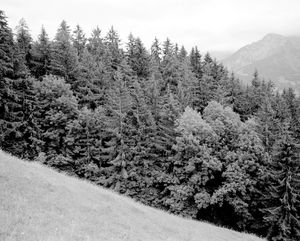
Animated gif with sound, made in collaboration with Sybella Perry in Japan, 2011. https://soundcloud.com/sybella-perry/arashiyama
Digital image with sound, made in collaboration with Sybella Perry in Switzerland, 2011. https://soundcloud.com/sybella-perry/pines
Selection of diptychs from a dual slide projection, made in collaboration with David Angus from 160 images taken around the border of the E3 postcode, 2011.
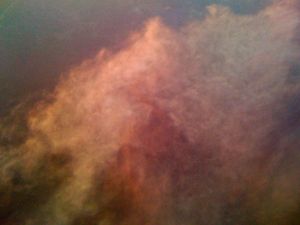
iPhone photographs with text by Matthew de Kersaint Giraudeau, 2012. Air France I guess it is part of my job? I’m like a buffer between him and the girls. The crumple zone. I take one for the team or whatever. It isn’t actually part of my job. Just whenever I work, I stand on that side of the bar and fend off anything that gets a little too extreme. I think he is on the sick for his back. Or maybe he had an accident at work a long time ago and got compensation. Something like that. He does that thing that all the regulars do where they refuse to sit down on the bar stools, which really confuses the students - and makes them look a bit aggressive actually, the regulars. Though they aren’t really, apart from this guy, but it is more a psychological aggressiveness. As in the act of showing the barmaids the porn on his iPhone is aggressive. It’s an issue of appropriate behaviour, rather than physical imposition. The videos don’t necessarily get more explicit as he gets more drunk. But if I’m not there, then he will start making more comments about it, which makes some of the girls feel uncomfortable. Some of them are only 18 or 19. I don’t enjoy it, I find it uncomfortable. Possibly more than some of them. But I suppose he isn’t interested in me in the way he is interested in them. Because the students are constantly deferring to them, as though standing in the same pub for 20 years, drinking the same drink, and making pathetic conversation with the landlord is some sort of achievement. So the students never take the bar stools that the regulars never use, because they don’t understand why anyone wouldn’t want to sit down, so they don’t take them, and then there is this line of bar stools that no one ever uses - not the regulars, because they stand at the bar with two hands on the bar and their feet level with their shoulders, like they are weightlifters; and not the students, because they are too scared of the regulars to ask if they can take away the stools. The regulars laugh at the students, but really they in awe of their youth and sad that they never got to go to university. It isn’t even really porn, some of it is more like extreme performance art - really shocking stuff, lots of big objects being shoved in people, basically. And then shit and blood etc. So you can see why we try and stop him showing the girls. He stands near the crisps, a little apart from the other regulars, unless he wants to show them something on the phone, which they laugh at even if they find him a little awkward, and also he always has the newest phone so they are impressed by that. But again, the idea that you would want to impress the regulars is something everyone takes for granted except for me and maybe the landlord, who is teetotal and hates everyone who boozes in equal measure and really shouldn’t be running a pub at all. They all think I’m Australian because my Essex accent is slightly different from their London accent. Local means local for a reason. When the landlord is working, he doesn’t show the worst videos he has, which makes the landlord think he is harmless. And coupled with the fact that he hasn’t ever been violent, and he drinks premium lager (which in a pub where you can get a pint of Fosters for £1.95 is both rare and economically meaningful) means that we can’t bar him. Basically, it goes like this, he says something like oi Sarah come and have a look at this one and Sarah will be like no Terry I’d rather not, you always show me the really nasty ones and he says no no Sarah, this one is just a funny cat one and then I have to look enthusiastic and say, oi Tel let’s have a look then and then he sort of reluctantly shows me, and then I laugh and say oi Tel you sick bastard and then he goes back to his pint for a bit. It doesn’t happen all the time, maybe four nights of the week. He is in every day, obviously. And he’ll have about three new videos, and then show a few old “classics”. As long as I absorb about 70% of them, then he keeps himself to himself, otherwise he might start telling the girls he wants to show them something else and then laughing into his pint, and then he goes downstairs to the toilets for 20 minutes before closing and when he comes back up no one can look him in the eye. -- Containment is how I see it. I’m providing a valuable service to the community. Like the people who work for the Samaritans who won’t put the phone down on anyone who calls them, whatever they hear down the phone. Imagine that. Going in wanting to help, wanting to talk people through the toughest bits of their life, and then some perv takes a liking to your voice and keeps calling and calling until he gets you, and then takes up 10 minutes of your valuable, charitable time, heavy breathing and talking about your lovely tits and wanking off. Well, whatever. I wouldn’t work for the Samaritans anyway. But then this one day he comes in, I assume my position nearest the crisps - he doesn’t even realise we have this action plan by the way, he isn’t even aware that we switch places, just so that the girls don’t have to be near him. He starts up with oi Becky, Becky, have a look at this one and she’s like Terry, honestly, I’ve seen enough to last me a life time off of you, and I pretend to look interested and I’m like, go on then Terry let’s have a go then you freak. And then instead of a woman with a rugby ball, or some animal porn or whatever, he shows me these photos. And he flicks through a whole selection of them. These beautiful pinks and blues, snatches of land peeking up through the clouds. Curved earth visible beneath. Watercolours almost, but obviously taken on the phone. What is funny is that he has the same face that he has when he shows me the porn, looking back and forth between me and the screen for approval. I tell the girls to come over and have a look, and then the regulars come over from their bit of the bar too, and I swear the music in the pub pauses, or least goes a bit quiet and you can hear us all breathing a bit slower and occasionally someone will point at the screen as if to say ‘that’s the one, that’s mine’. Really, the feeling is that we all wish we could have seen this from the plane. Somehow looked through the phone, through the window of the plane, and seen all this. Or that maybe we had seen this, on some flight or another, or in a dream. Maybe not the same clouds, but the same feeling. Of being above time, or maybe just out of reach of it. Chasing light that somehow miraculously bounces between the clouds and the plane. Each of the pictures melts into the next one, and I find myself telling Terry that they are really, honestly, beautiful and he responds to this with an embarrassed, pleased nod of the head, and it’s only later that I marvel at my use of the word, because normally I keep that sort of thing to myself because, well, it’s a pub, and beauty doesn’t come here very often unless you count Laura who works at the weekend, but she’ll leave soon. All the really nice ones leave and then they never even really say goodbye.
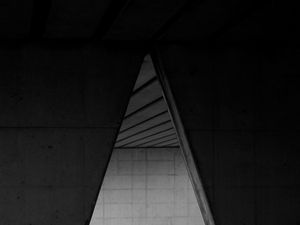
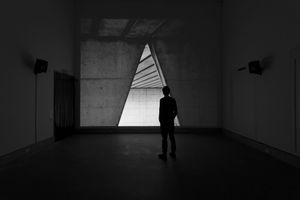
Waiting for the wave. (In January 2012 I spend a night with Tim and Nick whilst they take some of these photos. In the summer, I go out with them again to record some sound for an installed version of the Hind Land project to be exhibited in Portugal.) Tim, Nick and I are walking down a dark, overgrown path towards an underpass beneath the M25. Nick has a torch and he points it ahead of us, lighting the way. He stops for second and says “I think I just saw someone”. We all flinch with fear, but it's probably just kids messing about on the private land under the road. The motorway bridge is huge, passing over a river and a train line that we can hear but not see. We drink cans of beer and talk in whispers whilst I record the different sounds of the road. We forget about the person Nick saw on the way down here. We don't see any other movement until we finish the recordings, walk back up the path to our parked car, when suddenly two huge Alsatian dogs run out of a house and bark at us until we drive away. -- All around the M25 are underpasses: some of them are small openings that allow streams to run underneath the motorway; others are bridges, crossing small roads or footpaths; and some are concrete tunnels just wide enough for farmers to drive tractors between their fields, divided by the building of the road. Tim Bowditch and Nick Rochowski are, slowly but surely, visiting every one of these crossings - circling the motorway and photographing the incidental subterranean environments created by the M25. -- I spent a winter's night with them down there, underneath the M25. When they said that they were taking long exposures, I thought they meant a minute, or maybe two. Actually, the exposures can take up to an hour, and that time is then doubled by the in-camera processing. That adds up to a long time crouching in the cold dirt beneath a motorway. They take the photos at night, that's why they need the long exposure times. The camera Tim and Nick are using for the project has an achromatic digital back. This means that it can take photos in almost total darkness because it picks up the entire light spectrum, including infrared waves. The camera takes in a huge amount of visual information. Concrete structures are rendered in breathtaking textural detail – looking closely at the prints is like taking a magnifying glass to the surface of another planet. -- These places are the sort of dead zones that feel haunted by unseen human activity. The M25 is right above you. You can hear the suspension of the road working constantly - echoing, clunking, swishing noises. The traffic is lighter at night, and standing under the bigger bridges you can pick out the approach of an individual vehicle, hear the 'be-doink' sound as it passes over the suspension directly above your head, and then a strange whistling sound as it speeds away. And this sound, back and forth above your head, is endless. The traffic doesn't stop and it doesn't know, or care, that you are listening. From far away the road sounds like the sea, almost soothing. Up close it is more like a factory. The noise never ceases and it is inseparable from the functioning of the motorway. If the road sounds like a factory, maybe the noise is the product of its strange, endless industry. Or maybe the noise is a symptom of some deep urban pathology - the tinnitus ridden ear canal of a giant. The photographs, unlike the motorway itself, are deathly quiet. No cars, no humans, no graffiti on the walls. The only plant life is dead, fallen under the rivers that run beneath the road. Tim and Nick are visiting a deserted world, and their photographs are quiet, detailed observations of their time spent there. -- The photographs allow you to examine the architectural details of the motorway. The poured concrete structures were created with 'shutters', moulds made from timber, and the concrete retains the mark of the wood grain on its surface. These shutter marks were a deliberate gesture in much Brutalist architecture – an aesthetic recognition of the building process. But who is ever going to spend long enough looking at these motorway bridges to form an aesthetic judgement? Most people only ever see the underpasses from a car, which doesn't allow much time to ponder the methods and materials used in their construction. With their intersecting planes of concrete and steel, the photographs make the underpasses look like greyscale temples - shrines to the motorway above. But the aesthetic of the underpasses was the product of base level pragmatism. Architects did make choices about how the structures would look, but form followed function in the most direct way possible. This is architecture to be ignored. I was going to say that some of the images seem to be without scale – but that isn't quite right. It’s more like some of the images are without human scale. Perspective is created within the photographs by the horizons of concrete and steel and water. The photographs work to their own scale. – Marc Augé wrote that motorways are non-places, transient zones that do not hold enough significance to be thought of as places. Then what are these underpasses, sitting as they do beneath the non-place of the motorway? They are the subterranean twin of the motorway non-place, inseparable from the road, but also invisible to it. Their only function is to allow cars, trains, water or pedestrians to pass through the space of the motorway. To come back again to the sound of these underpasses, everything you hear is also 'passing through', because sound itself is transient – a wave: a momentary transmission of energy through matter. These very static spaces are actually filled with momentary transmissions of energy: the sound, the vehicles overhead, the dripping water, the dog walkers who occasionally stroll through the pedestrian underpasses. And, for a few hours on some cold nights, Tim and Nick captured the other waves that fill the underpasses, the waves of infrared light that allowed these photographs to be taken. But even photographers come and go. A few hours crouching in the dirt is nothing compared the stillness of the concrete and steel of the motorway bridges. After everything else passes through, only the road remains, waiting for the next wave.
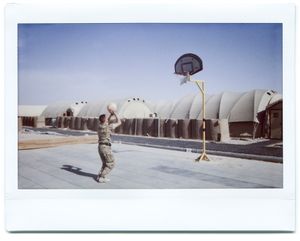
Tim and Matt Bowditch Afghanistan Blueys Tim Bowditch is a photographer. His brother, Matt Bowditch, is a bandsman in the Royal Marines. For his band duties, Matt is based in Exmouth, but in April 2011 he began a three month tour of Afghanistan. His main role for those three months was driving a Mastiff Ambulance providing medical support on Combat Logistic Patrols – regular convoys that provide supplies to troops all over Helmand Province. He was based at Camp Bastion, and in between driving as part of the convoys, he worked in the camps’ ambulance crews, and in other roles around Bastion. When Matt announced that he was going to Afghanistan, Tim decided that he wanted to collaborate with his brother on a photographic project. For Christmas 2010, Tim gave Matt a Fuji Instant camera, and enough film to last him for his three month tour. Tim asked Matt to take pictures of anything he liked, the only request was for 'quiet photos'. The three months of Matt's tour were marked by three packages of photos sent back to Tim in England. These packages are known as 'Blueys', taking their name from the blue paper which is used for letters to family and friends. Tim would choose his favourite images from the package, let Matt know which images he liked, and Matt's next batch of photos would be influenced by Tim's preferences. As soon as Tim saw the first photographs he knew that the project had a wider significance than just as a way of keeping in touch with his brother. -- These photos are from a part of the war in Afghanistan that we are not used to seeing. There are no images of combat, though its presence is never far away. There are no moments of obvious distress or danger. There are many images from 'outside the wire', when Matt was driving as part of the convoys, but there are also plenty of pictures from inside Camp Bastion. Whether on a gruelling 24 hour patrol duty, or just strolling around on his downtime, Matt managed to document the day to day life of the camp as someone who experienced it first hand. There are images of the desert, with long lines of armoured vehicles trailing across the endless horizon. There are images of people Matt worked with, in the camp and on the convoys. There are images of the practicalities of life on Camp Bastion - shower blocks, toilet blocks and telephone rooms all set up in huge shipping containers, Matt's equipment laid out for cleaning, the regular upkeep of the vehicles. And there are also strange, dreamlike images, like the bus stop in what could be the middle of the desert but is, in fact, ‘Leatherneck’, the American camp adjacent to Bastion. – When I spoke to Matt about his time in Afghanistan, he kept avoiding words which implied fear. He talked about excitement and adrenaline. Or he would talk around the idea of being scared, describing he had kept his head when his convoy came under fire. I asked him if he was avoiding the word 'fear', and he talked about how it wasn't useful – as a feeling or a word. I couldn't help relating this back to Tim's instruction for Matt to take 'quiet photos'. Maybe the sending and receiving of photos was method of mutual reassurance for Tim and Matt: two brothers, eager not to mention the possibility of death. Acknowledging that Matt was in a very dangerous situation wasn't going to make it any less dangerous, or any easier to stomach. So the photos don’t show us the danger. Instead, they show us minute details of living in the desert, the importance of personal relationships at the camp, the impressive mechanical technology of the vehicles, and the methods used by the Marines to relieve the tedium of downtime. Of course, Matt's photos can't quite ignore the memento mori that have a tendency to accumulate in warzones – guns, ambulances, fighter jets and artillery all make their appearances. But the images avoid sensational battlefield imagery, and instead concentrate on the day-to-day aspects of living and working as part of the military. -- This project began as a way for Tim to understand the experiences of his brother in the Marines. It became something much bigger - these photos are a significant document of the war in Afghanistan. They give us a way of understanding the hardship, the strangeness and the banality that make up the life of British service men and women serving in the country. They are also extraordinary images that remind us that beauty can be found everywhere, even in a war zone.

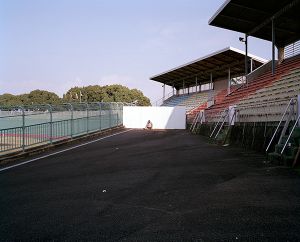
That is why the men are there: Big Dream Men, alone. Or in groups, but still alone. Facing away from each other – or, not so much away from each other as just facing different ways. Absorbed in their reading: numbers and words that are helping them make sense of what is happening in the surrounding environment. It is beautiful, by the way, the surrounding environment. It looks clean like concrete on a bright day looks clean. Very empty though. Space for everyone to stand or squat or sit on coloured plastic chairs looking at their newspapers that aren't really newspapers. When I say the surrounding environment, I mean a racetrack - a velodrome. I'm not trying to pretend it isn't a racetrack by describing the photographs as if it isn't obvious where they were taken. But I just want to recognise the strangeness of the photographs - as images, as situations - before we get any further. That's my first impression from looking at the photographs; of an out-of-time strangeness. But then maybe all photographs have that quality. Time removed from itself. The men in the pictures emanate this quality too, they are in-between one moment and another. They are frozen by the camera, caught considering their position; never to move on. Keirin, that is why the men are there. They are betting on Keirin races. Keirin is a form of track cycling that originated in Japan in 1948 and became an Olympic sport in 2000. That is what the men in the photographs are doing. They are looking at the form of the riders in the Keirin equivalent of the Racing Post, making notes and working out their bets. The photographs depict a lot of empty space. The space can clearly hold a lot of people, but there just aren't that many people in the space. I'm sure the space fills up sometimes. Weekends maybe. Special events, cup races. Somewhere else in the velodrome there are more people, crowds of people watching and betting on the races. Maybe people in couples or groups, talking or laughing or shouting for their favourite rider. But in these photographs there are just these clusters of men, alone. Gambling is illegal in Japan. Well, in general it's illegal, but there are some exceptions, and Keirin is one of them. The 'Public Sports' (the others being horse racing, motorboat racing and motorbike racing) are state run, and the government takes a cut of the money made from bets placed on the races. The pamphlet Tim picked up while he was at one of the tracks - Your Guide to Keirin for Beginners - makes much of the positive social uses of the gambling money. It has, the pamphlet promises, provided “equipment to be used in basic research for the treatment of lifestyle-related diseases”. Tim got speaking to a drunk guy at the velodrome who told him that most of the gamblers were jobless, homeless, or alcoholics. Maybe the lifestyle-related diseases are related to the lifestyle of the typical Keirin gambler. -- Big Dream is one of three projects that came out of Tim's trip to Japan. The other two, Leaf Peeper and Air France, are collections of photographs that happened without too much forethought: Tim took the photographs for Leaf Peeper whilst on a tourist trip to an Imperial Villa; and the photographs in Air France were all taken through the window of an aeroplane as Tim flew back to the UK. Big Dream, on the other hand, was researched and planned before Tim went out to Japan. He went to three race days at three different tracks, spending his time wandering around the betting areas, the stands, and the outside spaces. In the outside spaces he found these men, studying the form of the Keirin riders before they went inside to place their bets. Apparently the stands – where you bet or watch the race or get some food from a canteen – were really busy. But these outside spaces with their plastic chairs and vending machines and blank concrete were empty. That was where the men gathered, clumped and alone, to think and study and work out the odds. All of the photographs are peopled somehow. Sometimes they are pictures of people – the gambling men concentrating on their form sheets - and sometimes they are pictures of things. But the things are always a reminder of the people who are elsewhere: an abandoned form slip with a pen, or rows of plastic chairs awaiting their future sitters. My favourite thing-picture in the series is of two parallel rows of white bin-bags, full of losing betting slips. Here we see failure discarded, packed up, and quietly removed at the end of the day. The images in Big Dream manage to capture the infinite, unlikely, ever hopeful possibilities of gambling. The odds upon odds upon odds that make up a hypothetical win. All the men are facing in different directions, hoping for slightly different results. The concrete structures cut through the images, directing the gamblers along different paths, towards different futures. The spaces depicted by the photographs are in-between, non-places, they are on the way to somewhere else – the betting counters or the track-side stands. And the sport itself is a means to an end for the gamblers; a temporary diversion on the way to the pure adrenaline of a big win. 'Big Dream' is a Keirin-specific betting term. It is an accumulator bet, placed on the last four races of the day. If you pick the first two finishers in those races, you can win a huge amount of money. 'Big Dream' – it is a term that seems literal and clunky, an endearing cliché of Japanese to English translation. But it perfectly describes the feeling of looking at these photographs. The concrete is almost shining in the sun, gleaming with promise. The air is clear and feels clean. The men in the images are frozen in hope. They've worked out the odds, put in the time. There is no reason that today shouldn't be their lucky day.
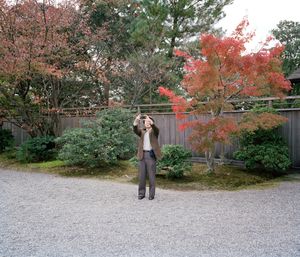
Leaf Peeper is a book about "Momijigari", the Japanese tradition of visiting scenic places in autumn to see the leaves of the trees as they turn red. Tim Bowditch's photos follows a Japanese man on the tourist trail around an Imperial villa in Kyoto as he takes endless pictures of the darkening leaves. A text by Matthew de Kersaint Giraudeau responds to Bowditch's photos with a story of insight, ignorance and blocked sinuses. I’ve not even been to Japan. Also, I don’t understand where his clothes came from. Like, where in my mind the idea for him being dressed like that would have come from. Though I think he looks pretty cool. Just not in a way I could actively visualise. It’s not like that’s some pre-existing idea I have of stylish dressing, and I haven’t seen it anywhere. I haven’t remembered it from somewhere and reproduced it, though I guess the whole thing would be an act of my subconscious anyway, so I wouldn’t necessarily know. I’ve always had trouble with my sinuses - it’s not like recently it has been particularly bad. It comes and goes. The headaches were bad, but I honestly don’t think I’ve had one for maybe a year. I think I have small nostrils. Restricted air flow. Easily blocked. It is definitely worse when I drink alcohol. I think maybe just the sheer amount of liquid. You never think about that do you? But when you drink beer all night you’re ingesting like 10 pints of liquid. That’s mental. You wouldn’t sit down and drink 10 glasses of water in five hours. You’d die. Water on the brain like that pilled up girl in the nineties. I remember reading about that at the time and thinking that drugs were really scary and then later when I was older and doing drugs, thinking that her friends were morons for letting her drink all that water. Plus when you realise that almost all drugs are better when you're pissed then the idea of drinking water goes out the window anyway. Now I’m thinking about how good it would be to have a suit like that. One you could wear all the time. Because in the dreams he is always wearing that suit, with the little hat, and then in the kebab shop he was wearing it too. It could be something to do with the wheat or something - the wheat in the beer. Maybe that makes my sinuses worse. I always think that everyone probably has a bit of a wheat intolerance, and also maybe lactose. Cow’s milk is weird - apparently we just aren’t built for it. Come to think of it Japanese people don’t eat milk products do they? And apparently westerners smell of milk. Anyway, I’m just not a hardy person. A weak stomach is a meaningful bodily metaphor for me. I understand it. Even as I’m writing this I’m feeling a bit jittery and nervous because I’m hungover and I’ve drunk some coffee, and it isn’t the caffeine making me feel weird, but the way my stomach reacts to the hot coffee. I can feel it, the metaphor, where it comes from. It’s not an analogy - it is just a straight description of a physiological state. So when I’m drunk I’m sort of breathy. Not wheezing or coughing, just a mouth breather - maybe some sniffing. Specially in the cold - and then coming into the heat of the kebab shop so warm like that. My glasses would have steamed up, I’m sure of that - though I can’t remember it happening. Maybe that’s why I didn’t see him when I first walked in. Because I would have recognised him, from the dreams. Definitely. He’s been there for years. Always the same, I follow him round these gardens. This old Japanese guy, and he is oblivious because he is taking photos of all the leaves which are all golden and brown which is beautiful but sort of morbid as well. The dream is really about the feeling - I have no idea why he is Japanese - the feeling that he is going to turn around at any moment and the situation is going to be embarrassing and hard to explain. Actually, maybe there is something about how I’m in his country and I’m acting wrong Like doing something that is customarily incorrect. I suppose maybe that fits with my sort of limited and stereotyped knowledge of Japanese culture. Like, it being a culture where social interaction is more strictly ritualised and you could definitely get it “wrong”. It’s weird that idea, because in one way it would actually be a relief to know what is and isn’t socially appropriate. Like I hate how I’m never quite sure about the politeness of kissing - and my family is French, so I should know, which makes it worse. For a bit they did three kisses, which threw everyone. No one knows where it started but there was about a two month period where we kept getting it wrong because the three-kiss-meme had got in somewhere and no one knew if this was a temporary fashion to be endured, or a permanent paradigm shift to be embraced, or a just a mistake. Anyway so I find the whole thing awkward, and the handshake for the man and the kiss for the lady - that sets me off too. My inner teenager recoils at how conservative it is, but then if you do it wrong then everyone’s embarrassed - even if it’s through choice, i.e. you are actively not doing the appropriate thing because you feel like its inherently misogynistic or whatever, but actually you still come across as socially awkward. But, if you had proper rules - not just expectation but like formal bullet pointed instructions - not written down or anything, but just understood as immutable laws, rather than just our wishy washy ‘oooh that’s a bit embarrassing that he didn’t shake his hand’ - maybe that would be better because you would have to do stuff, and not doing it wouldn’t be an option. I’d already ordered my kebab and sat down and was waiting for it. The kebabs are served in naan bread and are really weird and definitely only an option when you’re pissed, but they are ok. Like the meat isn’t so ugly, though it is from a spinning doner meat hulk. And the salad is good and the chilli and garlic sauce is good and they are nice guys who run the place. And maybe I was making a breathy noise or sniffing or something but suddenly I look up and he is right in my face saying ‘Do you have trouble with your breathing?’ and this is where perhaps I agree with my friends that maybe it didn’t really happen because he had a Geordie accent, which is obviously incongruous with him being Japanese. It could happen I suppose. But what was a Japanese Geordie doing in London? I suppose that isn’t the issue. It's just his age. He must be a first generation migrant, but if he was first generation then his English would have a Japanese accent, not a Geordie accent. Wouldn't it? He was really pissed, but in the dreams he isn’t , he is just taking photos with his digital camera in these gardens and I’m following him round the gardens and he is very still and quiet and just concerned with the photos he is taking. Part of me, in the dream, is wishing that I was doing a task that took concentration and was meditative in its repetition and in how much attention it requires, instead of following this guy around which is worrying and tense and could at any moment turn into something really embarrassing if he turns round and spots me. His kebab was open, on the counter, and the guy is waiting for him to make his sauce choice. The shop is tiny. There’s like a counter, and a plastic chair, and a sofa and a table. So how I missed him when I walked in I don’t know. But then after asking me whether I have trouble with my breathing, and me sort of looking taken aback but nodding or at least giving some sort of positive physical signal that yes, I did have trouble with my breathing, he takes both hands and pushes his thumbs onto the bony bit of my cheeks below my eyes, with his fingers wrapped back below my ears and pushes really hard with his thumbs and sort of shouts “Breathe! Breathe! Breathe!” at me. The timing of each “Breathe!” is such that I am obviously meant to breathe in when he says it. Also he isn’t really shouting but in the context of the small kebab shop with its restricted space and its warmth and the overall quietness of the place, it feels very loud. Commanding, at the least. Definitely not an offer you could refuse. Though I stress that it didn’t feel intrusive or violent, although when I’m drunk I tend to enjoy any sort of physical contact. And I’m aware of how strange that sounds but I’m not going to explain it further if you don’t already know what I mean. The dreams come and go. But they always inspire that same feeling of potential embarrassment. But in dreams these psychic-states are like, pure and are not so directly linked to the context of what is happening. So it’s not like I could pinpoint the exact reason for the connection between the feeling and the Japanese guy. Now the more I think about it, the more morbid it is, him taking these pictures of the dying leaves. Which I suppose the trees aren’t dying, but it feels morbid still. Also, dying leaves always remind me of the smell of cum, when they are piled up on footpaths and decaying. Bleach and cum. But maybe in Japan it doesn’t smell like that. The dream feels crisp and cool, but not cold. And dry, not wet. Not mouldy like in England. Clear cut. I don’t look up but if I did the sky would be pale blue and empty. It worked. He takes his hands away and suddenly my nose is clear and I can breathe and I just sort of stand up and point at my own face and breathe in and out proudly. He steps back as if to admire his handiwork. He puts his hands behind his back and nods towards me and smiles and turns to the counter. He sorts his sauces out for his kebab I suppose, but I don’t notice because I’m too busy breathing and shaking my head in disbelief. Which, again, don’t get me wrong, my nose is occasionally clear, but I suppose I’d never thought that you could just clear it like that with a physical action. I’ve tried it since and it hasn’t worked. But, there is quite a good thing where you tilt your head back and hold your breath and that does work sort of. But anyway, like I said it isn’t a debilitating condition so it's not like I’m desperately searching for some way of clearing my nose. But is it more morbid that I’m following him while he does it? Like watching someone capturing death over and over, but my feeling is not of death or fear about death, but fear of embarrassment. What does that say about someone? That when confronted with death all they can worry about is the possibility of a socially awkward situation? But then I’m following him, so I must be fascinated by death too, just not brave enough to look at it directly. But the leaves aren’t actually dying, they are just falling as part of the life cycle of the tree, so at best it is a metaphor for death, rather than an actual presentation of mortality. I am worrying about the embarrassment of being caught watching someone else taking pictures of a metaphor of death. Which is either not so bad or much much worse. I don’t know. I didn’t see him leave. I think I just got my kebab and went home and by the time I got home my nose was blocked again. I told all my friends about it and they sort of thought the story was funny until I started talking about the dreams and then they looked more dubious, then when I said about the Geordie accent I basically lost them completely.